
Living with multiple cats transforms the litter box from a simple household chore into a genuine management challenge. More cats means more waste, stronger odors, faster litter saturation, and a higher likelihood of territorial disputes that can quietly escalate into inappropriate elimination. The right setup — and the right maintenance rhythm — makes the difference between a fresh-smelling home and a constant battle against lingering ammonia.
This guide breaks down exactly what makes a litter box genuinely multi-cat ready, how to configure your boxes for harmony rather than conflict, and which maintenance habits actually keep things clean. Whether you're setting up a new multi-cat household or troubleshooting an existing one, you'll find practical, experience-tested guidance here. You can also read our guide on litter boxes for multiple cats.
Why One Box Is Never Enough
Before buying anything, internalize the single most important rule in feline resource management: n + 1. That means one litter box per cat, plus one spare. A two-cat home needs three boxes. Three cats need four. And so on.
| Number of Cats | Minimum Boxes | Recommended Layout |
|---|---|---|
| 1 | 2 | Two rooms, different floors if possible |
| 2 | 3 | Three separate locations, never side by side |
| 3 | 4 | Spread across at least two floors |
| 4 | 5 | Two "clusters" of 2–3, far apart |
| 5+ | 6+ | Multiple zones; consider one self-cleaning unit |
The reason isn't just capacity — it's resource security. Cats are territorial animals that control access to important resources. A confident cat can block a single box without any visible aggression: it simply sits nearby, and the more timid cat stops using it. Weeks later, you discover a damp patch behind the sofa and wonder what changed. You can also read our guide on cat grooming how to keep your cat clean and comfortable.
A common mistake is lining three boxes up against one wall and calling it "plenty of boxes." To a cat, that's a single resource in a single location, not three. If a dominant cat camps at that end of the room, all three boxes are effectively off-limits. Spread them across different rooms and floors. For more on the behavioral dynamics behind this, the ASPCA's guidance on litter box issues is an authoritative reference worth bookmarking.
What Actually Makes a Litter Box Multi-Cat Ready
Marketing language is generous with phrases like "multi-cat" and "extra capacity." Here's what genuinely matters when several cats share equipment. You can also read our guide on cat litter box mats best.
Size and Interior Dimensions
The functional guideline: a box should offer at least 1.5 times the length of your largest cat, measured from nose to base of tail. For an average 10-pound domestic shorthair, that's roughly 22–24 inches of interior length. For a Maine Coon or large Ragdoll, you're looking at 30 inches or more — which is why so many experienced owners end up repurposing storage totes or under-bed containers and cutting a smooth entrance.
Width matters as much as length. Cats need room to turn around, dig, position, and dig again. A cramped box produces two telltale symptoms: waste deposited right at the entrance, and cats standing with front paws in and back paws out. If you see either behavior, your box is too small — regardless of what the label claims. You can also read our guide on litter box mats for cats.
Litter depth is separate from box height. Aim for 3 inches of litter — enough for natural digging, not so much that it spills. Box walls of 8–10 inches contain scatter without creating a climbing challenge for older cats. If you need more interior space, our guide to extra-large litter box options covers the models worth considering.
Entry Height and Accessibility
Multi-cat homes often span multiple ages and mobility levels. A three-year-old vaults into a high-sided box without thinking; a twelve-year-old with early arthritis does not. Signs a box is too tall include hesitation at the rim, hind-leg wobble on exit, or accidents directly beside the box. You can also read our guide on self cleaning litter boxes for cats.
For senior or arthritic cats, look for an entry lip of 4–6 inches, or place a low step in front. The same accessibility thinking that drives low-entry feeding stations applies here — comfort determines whether a cat uses the resource at all.
Material and Surface Finish
Not all plastic is equal. What you want:
- High-density polypropylene or HDPE — non-porous, resists scratching, doesn't absorb ammonia
- Smooth, seamless interior — corners and molded seams trap waste; clumps stick to scratched plastic
- No textured grip bottoms — they look practical and are miserable to scrape clean
- Stainless steel — genuinely superior for odor (completely non-porous, dishwasher-safe, lasts a decade) but heavier, noisier when litter is scratched, and significantly more expensive
In practice, a cheap plastic box in a three-cat home develops a permanent ammonia note within 6–10 months no matter how well you clean it. Micro-scratches from claws and scoops hold urine salts. Budget on replacing basic plastic boxes annually; a quality box should last three to five years. You can also read our guide on best automatic cat feeders for arthritic cats low entry.
Odor Control That Works
Ignore claims about "odor-eliminating plastic." Real odor control in a shared box comes from three things:
- Volume of clean litter — 3 inches of good clumping litter absorbs and seals
- Scoop frequency — twice daily in a multi-cat home, non-negotiable
- Airflow or containment — either a hood with an activated-carbon filter, or an open box in a ventilated space
Carbon filters are real technology, but they saturate. Replace them every 30–60 days or they're just a piece of grey fabric. Most owners never replace them once, which is why hooded boxes develop a bad reputation.
Ease of Cleaning
Test any box mentally against this question: can I dump, scrub, rinse, and dry it in under five minutes? Features that help:
- Removable lid with simple latches (not fiddly clips that snap)
- No internal ledges, drainage channels, or molded ridges
- Light enough to lift when full — a full 24-inch box holds 15–20 pounds of litter
- Rounded internal corners
If you're comparing specific models across these criteria, our breakdown of top-performing litter box designs covers the units worth a second look. You can also read our guide on best rated cat litter box.
Open vs. Enclosed vs. Top-Entry: Honest Trade-offs
| Design | Best For | Weakness | Multi-Cat Verdict |
|---|---|---|---|
| Open pan (high-sided) | Nervous cats, seniors, homes with tension | Odor escapes; visible | Safest default — no ambush risk |
| Hooded / enclosed | Odor containment, tidy living rooms | Cat can be cornered inside; traps ammonia | Only with confident, non-territorial cats |
| Top-entry | Heavy diggers, dog-proofing, litter scatter | Hard on senior joints; poor escape route | Good for young athletic cats only |
| Corner / triangular | Tight apartments | Small interior, awkward to scoop | Use as a supplementary box |
| Self-cleaning / automatic | Busy owners, 3+ cats | Cost, noise, litter type restrictions | Excellent as one unit in a mixed setup |
The escape-route principle is the reason open boxes tend to work best in multi-cat homes. Cats are both predator and prey, and eliminating is a vulnerable moment. A hooded box has one exit. If another cat parks at that exit — even playfully — the cat inside is trapped. Many "spraying" and "avoidance" problems in multi-cat homes trace directly back to this single design flaw.
If you love the tidiness of a hood, a reasonable compromise is a large hooded box with the door flap removed and clear sightlines, plus at least one open box elsewhere in the house. Let your cats vote with their paws — they will. You can also read our guide on best automatic cat feeders for cats with asthma respiratory conditions.
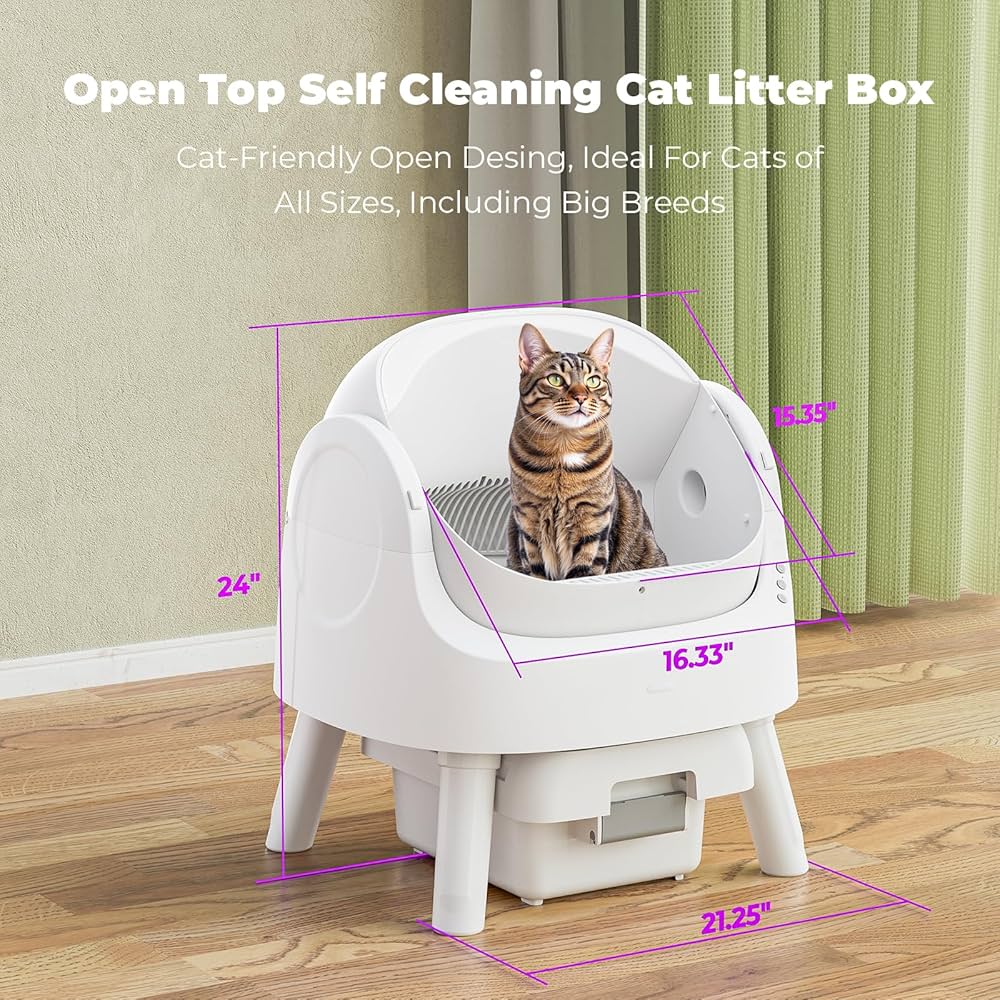
Self-Cleaning Boxes in a Multi-Cat Home: What to Know
Automatic boxes have improved considerably, and in a home with three or more cats they can genuinely transform your daily routine. But they come with conditions that many buyers discover too late.
What they do well:
- Rake or rotate waste into a sealed compartment within minutes of use, so the next cat finds a clean surface
- Dramatically reduce ambient odor because waste is sealed, not sitting in the litter
- Many now log usage per cat via weight sensors — genuinely useful early-warning data for urinary or kidney issues
Where they fall down:
- Litter restrictions. Nearly all require hard-clumping clay litter. Crystal, pine pellets, walnut, and most paper litters jam the mechanism.
- Cat size. Weight-sensor models typically need a cat over 4–5 pounds to trigger the cycle properly; kittens can be missed entirely.
- Noise. Even "quiet" motors are audible. Nervous cats may avoid the unit for weeks.
- Introduction time. Run it unplugged with litter in it for a week before switching it on. Rushing this is the most common reason an expensive unit ends up gathering dust in a cupboard.
- They still need manual cleaning. The waste drawer needs emptying every 3–7 days in a multi-cat home, and the whole unit needs a full strip-and-wash monthly.
Practical setup: Don't replace all your boxes with automatics. Run one automatic plus two or three conventional boxes. That way a mechanical failure, power cut, or a cat who dislikes the noise doesn't leave anyone without an option. You can also read our guide on how to introduce my cat to a new kitten.

High-capacity enclosed box with wide entry and generous interior depth — both essential when several cats share equipment.
Image source: www.elspet.com
Choosing Litter for a Shared Box
The box is only half the system. In a multi-cat home, the litter does more work because it's absorbing three or four times the volume.
Litter Types Compared
| Type | Clumping | Odor Control | Dust | Tracking | Notes |
|---|---|---|---|---|---|
| Sodium bentonite clay | Excellent | Excellent | Medium–high | Medium | The multi-cat default; cats overwhelmingly prefer it |
| Low-dust / heavy clay | Excellent | Excellent | Low | Low | Best clay choice for asthmatic cats |
| Silica crystal | No | Very good | Low | Low | Poor for multi-cat — saturates fast, no waste removal |
| Pine pellets | Breaks down | Good | Very low | Medium | Needs a sifting box; texture divides opinion |
| Walnut shell | Good | Good | Medium | High | Stains light flooring |
| Paper pellets | No | Fair | Very low | Low | Primarily for post-surgical use |
| Tofu / plant-based | Good | Good | Low | Medium | Flushable claims vary by region — check locally |
Texture and Scent
Cats have a strong preference for fine-grained, sand-like litter. This is consistent across feline substrate preference research and matches what most owners observe. Coarse pellets are chosen by owners, not cats. You can also read our guide on how to introduce new kitten to cat.
Skip the scented litter. A cat's olfactory sensitivity vastly exceeds ours; a floral deodorizing perfume that reads as "fresh" to you can read as "chemically contaminated" to them. If you need extra odor help, use an unscented sodium bicarbonate–based additive sprinkled under the litter rather than a perfumed formula.
Cats with respiratory sensitivity need particular care — heavy dust from pouring clay litter is a genuine irritant. Pour slowly, low to the box, and choose a low-dust formula. You can also read our guide on wet cat food recommended by vets.
Depth and Refresh Rhythm
- Working depth: 3 inches. Below 2 inches, urine reaches the base and clumps break apart on scooping. Above 4 inches, cats scatter it and you waste money.
- Top up daily to replace what you scooped — about half a cup per removed clump.
- Full replacement: every 2–3 weeks for a heavily used multi-cat box; up to 4 weeks for a lightly used spare box.
Diet also affects litter performance and odor. Poor-quality protein sources produce stronger-smelling stools. If odor is disproportionate to volume, food quality is worth reviewing — our overview of vet-endorsed wet food options is a sensible starting point, and cats with existing health conditions may need something more specific, such as diets formulated for senior cats.
Where to Put the Boxes
Placement causes more litter box failures than the box itself. Here's how to get it right.
Spread, Don't Cluster
Distribute boxes across different rooms and different floors. In a two-storey home with three cats, two boxes upstairs and two downstairs is far better than four in the utility room. You can also read our guide on wet food for cats with liver disease.
Give Every Box Two Exits
Avoid dead ends — the back of a closet, a tight alcove, behind the washing machine. A cat should be able to see approaching traffic and leave in more than one direction. This single change resolves a surprising number of "my cat suddenly stopped using the box" cases. If you're working with limited space, a litter box enclosure can provide privacy without creating a trap — just ensure it has multiple openings.
Quiet, But Not Isolated
Avoid placing boxes:
- Next to a washing machine or boiler (sudden noise creates permanent aversion after one bad experience)
- Beside food and water bowls — cats will not eliminate near their food source
- Busy hallways, near external doors, or in front of floor-level windows where outdoor cats are visible
- Damp, unheated garages that seniors will avoid in winter
Prefer: a spare bathroom, a quiet corner of a bedroom, a wide landing, or a laundry room with appliances not directly adjacent. You can also read our guide on best way to groom a long haired cat.
Lighting
Cats need enough light to find and evaluate the box at 3 a.m. A cheap motion-activated LED puck near each box is one of the highest-value, lowest-cost improvements you can make — especially for older cats with declining vision.
During Introductions
When you bring a new cat home, resource competition spikes. Add an extra box before the newcomer arrives, in the room they'll be confined to initially. Our guide on training a cat to use the litter box covers the foundational steps, and there's a companion piece on litter box training basics if you're starting from scratch. You can also read our guide on best grooming brush for short hair cats.
The Maintenance Routine That Actually Works
Cleanliness isn't a weekly event. Here's a realistic schedule for a multi-cat home.
Daily (4–6 minutes total)
- Scoop every box twice — morning and evening. Cats produce 2–4 urine clumps and 1–2 stools daily each; a three-cat home generates 9–18 items a day.
- Top up litter to maintain 3 inches.
- Sweep or vacuum the mat area.
- Empty the waste bin — a dedicated sealed litter pail beside the box saves trips and contains smell.
Weekly
- Wipe box rims and outer walls with warm water and unscented soap (cats' faces and paws contact these constantly).
- Wash or shake out litter mats.
- Rotate which box gets the deep clean — in a 4-box home, deep clean one per week rather than all four at once.
Every 2–3 Weeks (per box)
Full strip-down:
- Empty all litter into a bin bag — never down a drain.
- Wash with warm water and unscented dish soap, scrubbing all corners.
- Rinse thoroughly — residue deters cats.
- Dry completely — even slight damp makes fresh litter clump to the base.
- Refill to 3 inches.
Monthly
- Replace carbon filters in hooded boxes.
- Deep clean automatic units — remove the rake or globe, wash the waste drawer, wipe sensors.
- Inspect boxes for cracks and deep claw scoring; scored plastic holds odor permanently.
What Never to Use
| Avoid | Why |
|---|---|
| Bleach | Reacts with urine ammonia to release chloramine gas |
| Ammonia cleaners | Smells like urine to cats — invites re-marking |
| Pine oil / phenol cleaners (Pine-Sol, Lysol) | Phenols are toxic to cats, who lack the liver enzymes to process them |
| Essential oils (tea tree, citrus, eucalyptus) | Toxic to cats; strongly aversive |
| Scented antibacterial sprays | Perfume residue drives box avoidance |
Plain unscented dish soap and hot water is the correct answer for routine cleaning. For genuine disinfection after illness, a dilute unscented bleach solution rinsed extremely thoroughly and fully dried can be used — but rinse three times and air out the box before returning it. The FDA's animal health resources provide authoritative guidance on household product safety around pets.
Managing Odor Beyond the Box
Even with perfect scooping, a multi-cat home needs environmental support.
Ventilation first. Odor is airborne ammonia. A small extractor fan or a cracked window in the litter room does more than any air freshener.
HEPA air purifier with activated carbon. Position it 3–6 feet from the litter area, not directly beside it (dust clogs the filter). Carbon is the component that handles smell; HEPA alone won't.
Sealed waste storage. A dedicated litter disposal pail with a carbon-lined lid contains 24 hours of waste with no odor bleed.
Baking soda under the litter. A thin layer at the bottom of the box, before the litter goes in. Cheap and genuinely effective.
What to avoid: plug-in scent diffusers, aerosol sprays, and scented candles near the litter area. They mask nothing, cats find them aversive, and some contain compounds best kept away from feline respiratory systems.

Wide-format pan with a low front lip — the shape that works for mixed-age households where seniors and young cats share resources.
Image source: www.amazon.com
Controlling Litter Tracking and Scatter
Tracked litter is the complaint that outlasts odor. In a multi-cat home, the volume compounds fast.
Layered defense:
- High-sided box (8–10 inch walls) stops the digging spray at source
- A proper litter mat — not a thin rubber sheet. Look for a dual-layer honeycomb design that traps granules in a lower chamber, or a deep-pile EVA foam mat. Minimum 24 × 30 inches; place it so the cat takes at least two full steps on it
- A runner strip between the box and the room exit for heavy trackers
- Litter choice — heavier clay granules track less than lightweight or crystal formulas
- Trim tufts between paw pads on long-haired cats; this is where most tracking originates
That last one is significant. Long-coated cats collect litter in the fur between their toes and around the britches, then distribute it across the house. Regular attention here — and to the hindquarters generally — cuts tracking noticeably. Our walkthrough on grooming long-haired breeds covers the technique; if you prefer to keep your cat's coat manageable at home, a self-grooming wall brush can also reduce loose fur and debris.
Common Mistakes to Avoid
Too few boxes. By far the number one cause of multi-cat litter problems. Count again: cats + 1, in separate locations.
Boxes in a row. One location, not several. Separate them.
Buying for your décor, not your cats. Furniture-style enclosures and small covered boxes look great and frequently go unused. If you buy one, add an open box nearby as an alternative and see which gets used.
Switching litter abruptly. Cats form substrate preferences early and change reluctantly. Transition over 7–10 days: 75/25, then 50/50, then 25/75. Switching all boxes at once means a cat who dislikes the new litter has nowhere acceptable to go.
Over-cleaning with strong products. A box that smells of chemicals is as unusable as one that smells of urine.
Assuming behavior changes are "attitude." A cat who suddenly avoids the box, strains, vocalizes while eliminating, or produces tiny frequent urinations may have a urinary tract issue. In male cats, straining with little or no output is a veterinary emergency — a blocked urethra can become fatal within 24–48 hours.
Ignoring the quiet cat. In multi-cat homes, the cat being blocked from the box is rarely the one making noise. If one cat's clumps are noticeably smaller or less frequent, watch the traffic patterns around the boxes.
Never replacing the box. Plastic ages. If a scrupulously cleaned box still smells within a day of a full change, its useful life is over.
Monitoring Health Through the Litter Box
The litter box is the best daily health monitor you have — and in a multi-cat home it's also the hardest to read, because you can't easily tell whose output is whose.
What to track:
- Total urine clump count. Roughly 2–4 per cat per day. A sudden increase across the household can signal diabetes or kidney disease in one cat.
- Clump size. Very large clumps suggest increased drinking; multiple tiny clumps suggest urinary irritation or a partial blockage.
- Stool consistency and frequency. One formed stool per cat per day is typical. Persistent softness, mucus, or blood warrants a vet call.
- Absence. No stool for more than 48 hours from a cat is worth investigating.
Identifying which cat: temporarily separate cats into different rooms with their own box for 24–48 hours; use a weight-sensing automatic box that logs per-cat visits; or add a pinch of vet-supplied, food-safe tracking dye to one cat's food. Never guess — treating the wrong cat wastes time on a clock that may be short.
Set a standing rule: if litter box habits change and stay changed for more than 48 hours, book a vet appointment. It is far more often medical than behavioral. If you're also managing other aspects of feline health, our guide to cat oral hygiene explains why dental care matters for overall wellbeing.

Contemporary large-capacity unit with sealed waste storage — the two features that matter most when several cats share a box.
Image source: neakasa.com
Special Situations
Kittens
Kittens need low-sided boxes (2–3 inch entry) and should be kept away from automatic units until they're over 5 pounds and reliably trigger sensors. Use unscented, non-clumping litter for kittens under 8–10 weeks, as some will taste-test the substrate. If you're raising a young cat, our guide to training kittens to use a litter box walks through the early steps.
Senior and Arthritic Cats
Lower the entry, add a non-slip step, use softer fine-grained litter (hard pellets hurt sensitive paws), and add a box on every floor the cat uses. Older cats often can't make it up a flight of stairs in time.
Cats Recovering from Surgery
Switch temporarily to paper pellet litter — clay granules stick to incisions and cause infections. Return to normal litter only once your vet clears it.
Overweight Cats
Need the largest box you can source, with the lowest practical entry. A standard 18-inch box is functionally too small for a 16-pound cat.
One Cat Bullying Another Away from the Box
Add boxes in the victim's core territory — where they sleep and eat. Provide vertical escape routes near each box (a cat tree or shelf). If it persists, this is a genuine behavioral case rather than an equipment problem, and a certified feline behavior consultant is the right next step. Some owners also find that deterrent products help manage territorial marking during the transition.
A Practical Buying Checklist
Before you order, run through this:
- Interior length ≥ 1.5× your largest cat's body length
- Wall height 8–10 inches (or 4–6 inches for seniors)
- Smooth, seamless, non-textured interior
- Removable lid or simple one-piece design
- Light enough to carry when full of litter
- Fits the intended spot with 12+ inches of clearance for the cat to approach and turn
- Compatible with the litter your cats already accept
- Enough total boxes to satisfy n + 1
- Matching litter mat, scoop, and sealed waste pail
- Budget for replacement in 1–3 years depending on material
Start with the box count, not the box. If you're currently short of the n + 1 minimum, adding two basic high-sided pans in new locations will improve your household more than any single premium purchase. Get the coverage right first — then upgrade one box at a time. If you're also considering toilet training as an alternative, our guide to DIY toilet training for cats explores that option in detail.
Frequently Asked Questions
Can multiple cats share one litter box?
They physically can, but they shouldn't. The established guideline is one box per cat plus one spare. A single shared box means the box is dirty far faster, and it creates a chokepoint a confident cat can guard. Sharing is one of the most common triggers for stress-related elimination outside the box, and the cost of avoiding it — two extra basic pans — is minimal.
Do vets recommend covered litter boxes for multi-cat homes?
Opinion is genuinely divided, and preference varies by cat. Hoods contain odor and litter scatter, which owners appreciate. The trade-off is that a hood has a single exit, which makes a cat vulnerable to being cornered — a real concern where there's any tension between cats. Hoods also concentrate ammonia inside, which matters for cats with respiratory sensitivity. If you use covered boxes, offer at least one open box as well and see which your cats actually choose. Their behavior is the definitive answer.
What is the golden rule for litter boxes?
One per cat, plus one — in separate locations, scooped at least once daily. Everything else is refinement. Layer on unscented fine-grained litter at about 3 inches depth, quiet placement with clear escape routes, and a full change every two to three weeks, and you've covered the fundamentals.
Is clumping litter better for multiple cats?
Yes, in almost every case. Clumping sodium bentonite lets you remove urine as well as solids, which is the only way to control odor in a box used many times daily. Non-clumping litter leaves urine sitting in the substrate until you change the whole box. Clumping litter is also what the vast majority of cats prefer texturally. The main exceptions are kittens under about eight weeks and cats recovering from surgery.
How often should I completely change the litter in a multi-cat box?
Every two to three weeks for a heavily used box, assuming you're scooping twice daily and topping up. If you can smell ammonia on a box you scooped that morning, change it immediately — that's saturation, not a scent problem. Boxes in lower-traffic locations can stretch to four weeks.
Are automatic litter boxes worth it with three or more cats?
For many households, yes — but as one box in a larger setup, not a replacement for all of them. The advantages are immediate waste separation, sealed odor containment, and per-cat usage data that can flag health problems early. The caveats are cost, litter restrictions (hard-clumping clay only, in nearly all models), motor noise, and a genuine acclimation period. Never make an automatic unit the only option available to your cats.
Why has one of my cats suddenly started going outside the box?
Assume a medical cause until proven otherwise. Urinary tract disease, cystitis, kidney problems, arthritis making the box painful to enter, and cognitive decline in older cats all present this way. Book a vet appointment. Only once a health issue is ruled out should you investigate behavioral causes — box cleanliness, a recent litter change, a new pet, a new box location, or another cat blocking access.
How can I stop litter being tracked all over the house?
Use a layered approach: high-sided boxes to contain digging spray, a proper dual-layer or deep-pile mat at least 24 × 30 inches, heavier clay litter rather than lightweight formulas, and regular trimming of the fur between long-haired cats' toes. Add a runner strip between the box and the room exit for the worst offenders.
The Bottom Line
A "multi-cat litter box" is a system, not a product. The single best box in the world, used alone by four cats, will fail. Four adequate boxes, spread across separate quiet locations, filled with unscented clumping litter at three inches, scooped twice a day and fully stripped every fortnight, will keep a multi-cat household clean and conflict-free.
Prioritize in this order:
- Enough boxes, in enough locations (n + 1, separated)
- Size and accessibility matched to your largest and your oldest cat
- Litter your cats actually choose — unscented, fine-grained, clumping
- A twice-daily scooping habit you can genuinely sustain
- Then, and only then, upgrade to premium or automatic hardware
Cats communicate discomfort through their toileting long before they show it anywhere else. Get the system right and the box becomes what it should be: an early-warning health monitor and a non-issue in your daily life.
Next step: Count your cats, count your boxes, and if you're short, fix that this week. Then compare our top-scoring designs to find the size, material, and price point that fits your home — and start with a setup your cats will actually use.