
If you scoop daily but still catch that sharp ammonia smell the moment you walk through the door, you're dealing with a chemistry problem, not a cleaning failure. Cat urine contains uric acid, which bacteria break down over time into ammonia and mercaptans—compounds that cling to litter, plastic, and nearby fabrics. The best cat litter box deodorizer doesn't simply perfume the problem. It binds to or breaks down those odor-causing molecules before they can become airborne. This guide explains how deodorizers actually work, which formulations suit different households, what to avoid for your cat's safety, and how to build a complete odor-control routine that works in 2026.
Why Litter Box Odor Is a Real Problem
Litter box odor isn't just unpleasant. Left unchecked, it affects your cat's behavior, your indoor air quality, and your willingness to have guests over. You can also read our guide on maine coon cat litter box.
The Science Behind the Smell
Fresh cat urine has a mild odor. The potent, eye-watering ammonia smell develops hours later, when naturally occurring bacteria start breaking down urea and uric acid. This process accelerates in warm, humid environments or in litter that stays damp at the bottom of the box. Simple fragrance sprays don't stop this reaction—they just layer a competing scent over the ammonia, which is why heavily scented products often make a litter box smell like a floral gas leak.
A true neutralizing deodorizer works one of three ways:
- Absorption — Materials like activated charcoal and zeolite trap odor molecules inside their porous structure.
- Chemical neutralization — Baking soda reacts with acidic compounds to reduce their volatility.
- Enzymatic breakdown — Protease and urease enzymes digest the organic compounds in urine that bacteria would otherwise convert into ammonia.
In practice, absorption-based products last longest, while enzymatic formulas work fastest on fresh messes.
Health and Behavioral Consequences
Cats have a sense of smell roughly 14 times more sensitive than humans. A litter box that smells overwhelming to you is exponentially worse for your cat. Felines that find their box offensive don't just tolerate it—they start eliminating elsewhere. This is one of the most common causes of inappropriate urination, which often leads to rehoming or surrender. For older cats or those with respiratory conditions, airborne ammonia can irritate airways and worsen existing issues. You can also read our guide on best cat litter box for odor control.
For humans, persistent ammonia exposure can trigger headaches, allergy-like symptoms, and discomfort for guests with asthma. The ASPCA notes that cats are also highly sensitive to many fragrance compounds and essential oils commonly used in masking products, which we'll cover in the safety section below.
Types of Cat Litter Box Deodorizers
Deodorizers come in several physical formats, each with distinct strengths and trade-offs. Understanding these helps you match the product to your maintenance style. You can also read our guide on wood pellet cat litter box.
Powder Deodorizers
Powders are typically based on baking soda, zeolite, or a blend of both. They're the most affordable per application and integrate easily into any standard litter box. You simply sprinkle a thin layer across the litter surface after scooping or mix it into fresh litter during a full change.
Pros:
- Lowest cost per use
- Easy to find at any pet or grocery store
- Unscented options are widely available
Cons:
- Needs reapplication every 2–3 days
- Can become dusty and tracked onto floors
- Overapplication causes clumping and may discourage digging
Powders make sense for single-cat homes on a budget, provided you're consistent with the routine.
Granular Deodorizers
Granules use activated charcoal, zeolite, or silica beads with a larger particle size than powders. This reduces dust and tracking while extending active life. Most granular formulas remain effective for 4–6 weeks per application, making them a strong choice for multi-cat households or anyone who wants lower day-to-day maintenance. You can also read our guide on litter box for old cats.
Pros:
- Longest interval between applications
- Low tracking compared to powders
- Highly effective at adsorbing ammonia and mercaptans
Cons:
- More expensive upfront
- Some cats dislike the texture under their paws
- May need to be mixed thoroughly for even coverage
If you're managing multiple boxes or a busy schedule, granules are usually the best return on effort.
Spray Deodorizers
Sprays divide into two categories with very different mechanisms. Enzymatic sprays break down urine proteins and uric acid on contact, making them ideal for accidents outside the box and for treating the box itself during deep cleans. Fragrance sprays merely cover odor temporarily.
Pros:
- Fast-acting spot treatment
- Enzymatic formulas work on old, set-in odors
- Useful for cleaning box walls, floors, and nearby surfaces
Cons:
- Shortest lasting—requires reapplication every 1–2 days
- Fragrance-only versions offer no real odor elimination
- Some formulas contain harsh or irritating ingredients
Keep an enzymatic spray on hand even if your primary product is a granule or powder. It's the right tool for accidents and monthly deep cleaning. You can also read our guide on litter box mats for cats.
Natural and Fragrance-Free Options
Natural formulations prioritize food-grade or mineral-based ingredients without artificial dyes, synthetic fragrances, or toxic additives. Active components are usually activated charcoal, baking soda, or plant-derived enzymes. They're the safest pick for kittens, cats with respiratory sensitivity, and households with small children.
Pros:
- Lowest irritation and toxicity risk
- No lingering artificial scent
- Good for sensitive users
Cons:
- May require more frequent application in heavy-odor homes
- Potency varies significantly by brand
A common mistake is assuming "natural" automatically means "safe." Some natural products still contain essential oils that are toxic to cats, so ingredient review matters regardless of the label. You can also read our guide on best rated cat litter box.

Unscented granular deodorizers work well for households with fragrance-sensitive cats.

Granular formulas resist tracking better than fine powders on carpeted floors.
How to Choose a Deodorizer That Actually Works
With shelves full of products making identical claims, focus on these four criteria to separate effective options from scented placebos.
1. Look for These Active Ingredients
Skip products that list "fragrance" or "parfum" as the primary feature. The active ingredients that genuinely neutralize odor include:
- Zeolite — A natural volcanic mineral with a highly porous structure that traps ammonia and sulfur compounds. Works for weeks at a time.
- Activated charcoal — Exceptional at adsorbing a wide range of volatile organic compounds. Common in granules and filter inserts.
- Baking soda (sodium bicarbonate) — pH-buffering action reduces acidic odor volatility. Inexpensive but requires frequent renewal.
- Enzymes — Protease, amylase, and urease break down the organic compounds bacteria feed on. Fast action, shorter lifespan.
A product that combines a fast-acting ingredient with a long-lasting one often performs best in real-world conditions.
2. Prioritize Cat Safety
Cats groom their paws and fur constantly, so anything you add to the litter should be safe for incidental ingestion. Avoid these ingredients outright:
- Phenol — Found in some disinfectant sprays; highly toxic to cats.
- Essential oils — Tea tree, wintergreen, citrus, pine, eucalyptus, cinnamon, and clove are all dangerous to cats. Even "natural" litter deodorizers sometimes contain these.
- Artificial dyes — Unnecessary and occasionally irritating.
The ASPCA's essential oil safety guidance for pet owners outlines which compounds to avoid. When in doubt, choose unscented mineral-based products over anything heavily fragranced.
3. Match Your Maintenance Style
Be honest about how often you'll actually reapply. If you travel frequently or have a demanding schedule, a 4–6 week granular product beats a powder that needs attention every other day. Conversely, if you scoop daily and enjoy the ritual, a powder's lower cost may matter more than its shorter lifespan. The most effective deodorizer is the one you'll use consistently.
4. Check Litter Compatibility
Different litters interact with deodorizers differently. Zeolite powders blend well with traditional clumping clay. Activated charcoal granules pair effectively with silica crystal litter. Enzymatic sprays work across all litter types because they act on the urine itself rather than the litter medium. If you run a pellet-based system, avoid fine powders that sift to the bottom and stick to the tray.
Top-Rated Deodorizers Worth Considering in 2026
While specific availability changes, these product categories and representative examples reflect what performs reliably for most cat owners. The table compares format, primary mechanism, and expected cost range.
| Product Example | Format | Key Mechanism | Best For | Approx. Monthly Cost |
|---|---|---|---|---|
| Arm & Hammer Litter Deodorizer | Powder | Baking soda + zeolite | Budget single-cat homes | $3–4 |
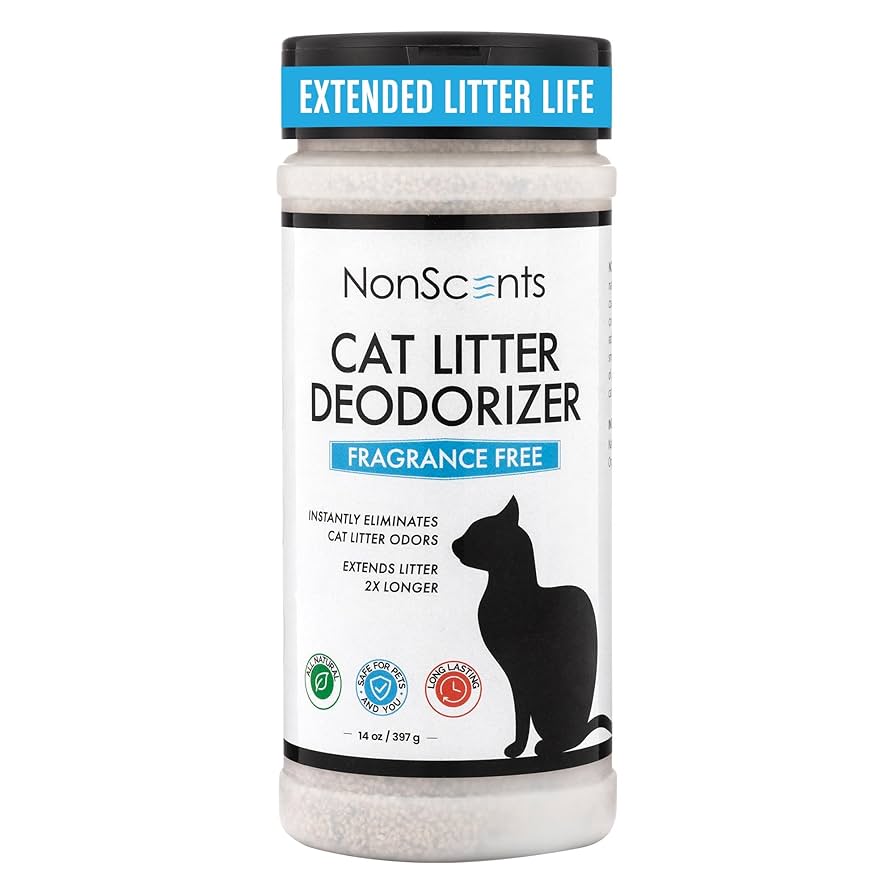
| NonScents Odor-Neutralizing Granules | Granules | Natural zeolite | Fragrance-sensitive, multi-cat | $5–6 |
| Nature's Miracle Advanced Enzymatic Spray | Spray | Enzymatic formula | Set-in odors and accidents | $4–5 |
| Fresh Step Litter Deodorizing Crystals | Granules | Activated charcoal | Long-gap maintenance | $6–7 |
Detailed Product Notes
Arm & Hammer Litter Deodorizer Powder remains a solid entry-level pick. The baking soda and zeolite blend works quickly on fresh litter, and the unscented version avoids fragrance-related problems. Its main limitations are dust and tracking, plus the need for reapplication every few days.
NonScents Odor-Neutralizing Granules uses zeolite without added fragrance, making it a reliable choice for homes where both cats and humans are sensitive to scents. In multi-cat setups, its 4–6 week active window means less intervention.
Nature's Miracle Advanced Enzymatic Spray is not a maintenance deodorizer so much as a targeted treatment. Use it on litter box plastic during deep cleans, on floors after accidents, and on fabrics that have absorbed urine odor. The enzyme action stops bacteria from converting uric acid into ammonia, which is why it works on old stains where surface cleaners fail.
Fresh Step Litter Deodorizing Crystals offers activated charcoal in a low-dust granular form. It mixes well with clumping litter and provides consistent odor adsorption without requiring a heavily perfumed environment.
For homes still struggling after upgrading the deodorizer, the problem is often the box itself. A larger litter box gives cats room to dig without kicking waste into corners, reducing the surface area where odor compounds accumulate.
DIY Litter Box Deodorizer Solutions
Store-bought products aren't the only option. These homemade solutions cost pennies per use and rely on the same active principles as commercial formulas.
Baking Soda Base Mix
Combine one cup of food-grade baking soda with one teaspoon of food-grade diatomaceous earth. Never use pool-grade diatomaceous earth, which is crystalline silica and dangerous to inhale for both humans and cats. Sprinkle roughly a quarter-inch layer under the litter when you refill the box. The baking soda buffers acidic odor molecules while the diatomaceous earth helps control moisture. Reapply at every full litter change.
Activated Charcoal Packs
Food-grade activated charcoal is available at pet supply and aquarium stores. Fill a small breathable pouch—an unbleached cotton tea bag or similar—and place it beside the litter box or on a shelf above it. Replace the charcoal every 4–6 weeks. If you place the pack inside the box, ensure it's secured where your cat can't chew through the fabric. This is an excellent passive solution for enclosed litter box cabinets.

Activated charcoal in a breathable pouch absorbs odor passively for weeks at a time.
Vinegar-Based Enzymatic Cleaner
Mix equal parts white vinegar and warm water in a spray bottle, adding a teaspoon of baking soda for extra buffering. Use it to wipe down the empty litter box during monthly deep cleans, then rinse thoroughly and dry before refilling. The vinegar odor dissipates as it dries. This is not a replacement for a commercial enzymatic cleaner on porous surfaces, but it's effective on plastic trays and nearby tile or vinyl flooring.
Important: Do not add essential oils to any DIY litter deodorizer. Many oils that smell pleasant to humans—tea tree, citrus, eucalyptus, peppermint—are toxic to cats even in small inhaled or ingested amounts.
Building a Complete Odor-Control System
No deodorizer works in isolation. The most impressive results come from layering a few consistent habits.
Daily Scooping Is Non-Negotiable
Scoop solid waste and urine clumps at least once daily—twice for multi-cat homes. The longer waste sits, the more uric acid breaks down into ammonia, and the more work your deodorizer has to do. If you're training a new cat or managing a stray you've brought indoors, establishing this routine early makes every other step easier; you can find a practical walkthrough for litter habits with a rescue cat.
Full Litter Changes on Schedule
Even with perfect scooping, fine particles and dissolved urine accumulate at the bottom of the box. For clumping clay litter, change everything every 3–4 weeks. For non-clumping litter, every 2 weeks is safer. Wash the empty box with mild, unscented dish soap and warm water, dry it fully, then apply your deodorizer to the clean tray before adding fresh litter.
Improve Placement and Airflow
A litter box in a closed closet or cramped corner traps ammonia and re-deposits it on the walls. Position the box in a room with passive airflow, and consider adding a small fan on low if the space is enclosed. An open-top box outperforms most covered boxes for ventilation, even if a cover hides the mess visually. If you prefer the look of a hidden box, choose an enclosed litter box cabinet with ventilation slots rather than a fully sealed design.
Pair Deodorizer with Quality Litter
A high-quality clumping litter does much of the heavy lifting by sealing urine into removable clumps before bacteria can act. If you're still using a basic non-clumping clay, upgrading your litter will do more for odor than any additive. For homes with multiple cats, a covered or self-cleaning box can reduce the amount of exposed waste between scoops, but only if your cats accept the mechanism.
Trap Tracking at the Source
Deodorizer and soiled litter particles that escape the box spread odor through the house. A textured mat in front of each box catches most debris before it reaches the carpet. If your cat is a vigorous digger, consider a box with higher sides or a tray-style litter box design that contains scatter more effectively.
Common Mistakes That Undermine Odor Control
Even conscientious cat owners sabotage their own efforts by falling into these patterns.
Masking Instead of Neutralizing
The biggest mistake is choosing a product because it smells strong in the store. A pleasant lavender or ocean-breeze scent signals cover-up, not elimination. Within hours, the fragrance fades and the underlying ammonia returns—often smelling worse because the nose now has two competing signals. Choose unscented or lightly scented products with proven neutralizing ingredients, and evaluate success by whether the odor disappears, not whether a new scent appears.
Applying Deodorizer to Dirty Litter
Deodorizer works on the compounds it can reach. If the litter tray is caked with soaked, ammonia-rich residue, a sprinkle of zeolite on the surface accomplishes almost nothing. You're layering a clean product onto a dirty base. Always scoop, clean the box, and add fresh litter before expecting any deodorizer to perform.
Overapplying Fragranced Formulas
More is not better. Cats have sensitive respiratory systems, and heavy fragrance can drive them to eliminate elsewhere—the exact opposite of the goal. Follow dosage instructions, and if one application isn't enough, the problem is usually maintenance, litter quality, or box location, not a need for triple the product.
Ignoring Medical Causes
Sudden, dramatic increases in urine odor can signal a health issue. Urinary tract infections, kidney disease, and diabetes can change urine concentration and smell. If your cat's litter box odor suddenly worsens despite unchanged routines, schedule a veterinary check before doubling down on deodorizers. Persistent inappropriate urination also warrants a vet visit rather than simply buying stronger products.
Frequently Asked Questions About Cat Litter Box Deodorizers
What is the most effective cat litter box deodorizer for multi-cat homes?
Granular zeolite or activated charcoal products generally perform best in multi-cat households. Their larger absorbent surface area handles higher urine volume, and their longer active window means you don't need daily reapplication. Pair with twice-daily scooping and a quality clumping litter.
Are scented litter deodorizers safe for cats?
Mildly scented products using pet-safe synthetic fragrances are usually tolerable for healthy adult cats. However, fragrance-free is always the safer choice, especially for kittens, seniors, or cats with respiratory issues. Avoid any product containing essential oils, phenol, or strong artificial perfumes.
Can I use baking soda as a litter box deodorizer?
Yes. Plain baking soda is safe, inexpensive, and effective at buffering acidic odor compounds. Sprinkle a thin layer under the litter, or mix one cup into five pounds of fresh litter. Use it sparingly—too much creates dust and may clump when wet.
How often should I replace my litter box deodorizer?
Powders typically need renewal every 2–3 days. Sprays last 1–2 days at most. Granules remain effective for 4–6 weeks. If odor returns sooner than expected, increase scooping frequency and check whether the litter itself needs a full change before adding more product.
Do litter box deodorizers work for ammonia smells?
Yes, but only neutralizing formulas address the root cause. Products containing zeolite, activated charcoal, or enzymes bind to or break down the uric acid and organic compounds that become ammonia. Fragrance-only products do not eliminate ammonia—they merely compete with it. Consistent scooping remains essential because no deodorizer can neutralize a large volume of fresh urine indefinitely.
The Bottom Line
The most effective approach to a truly odor-free litter area combines three elements: a genuinely neutralizing deodorizer, a consistent scooping and litter-change schedule, and good airflow around the box. For most households, an unscented zeolite or activated charcoal granule applied every 4–6 weeks provides the best balance of efficacy, safety, and convenience. Keep an enzymatic spray for accidents and deep cleans, and rely on a budget-friendly baking soda base if you have a one-cat home.
Before spending more on stronger products, evaluate the fundamentals. If the box is too small, placed in a stagnant corner, or rarely refreshed, no deodorizer will compensate. If you're introducing a new cat or rehabilitating a stray, patience with litter box training reduces accidents that create stubborn odor spots. And if your cat suddenly urinates outside the box or the urine smells dramatically different, talk to your veterinarian.
Start by changing your litter completely, deep-cleaning the tray, and applying a small amount of a tested neutralizing product. Measure success by how the room smells 48 hours later—not by how the product smells in the container. With the right chemistry and a consistent routine, "odor-free" is an achievable standard, not a marketing promise.