
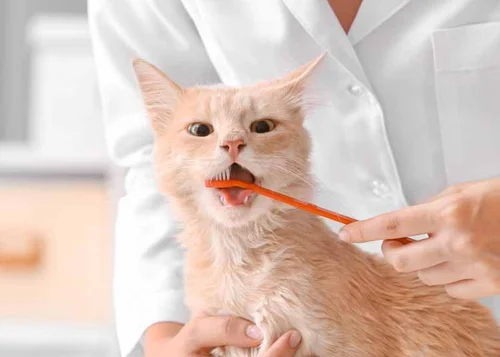
Yes — you should brush your cat's teeth, ideally every single day. It sounds absurd the first time you hear it, and most cat owners never do it. That's precisely why dental disease is one of the most common health problems veterinarians diagnose in cats, and why so many cats end up under anaesthesia having teeth extracted before their eighth birthday.
The good news: brushing a cat's teeth is far more achievable than it sounds, provided you go slowly and stop trying to do the whole mouth on day one. This guide walks through what actually happens inside an unbrushed feline mouth, how to choose tools your cat will tolerate, a realistic training plan, honest alternatives when brushing genuinely isn't possible, and the warning signs that mean a vet visit can't wait.
The Short Answer: Why Brushing Beats Everything Else
Plaque is a soft, bacteria-rich film that begins forming on tooth surfaces within hours of a cleaning. Left alone, saliva minerals harden it into calculus (tartar) in a matter of days. Once it's hardened, no brush, treat, chew, or water additive will remove it — only a veterinary scaling under general anaesthesia will.
That short window is the whole argument for brushing. A toothbrush is the only home tool that physically disrupts plaque at the gum line before it mineralises. Everything else — dental diets, gels, chews, wipes — slows the process down. Useful, but secondary.
The consequences of skipping it aren't cosmetic:
- Gingivitis — red, puffy gum margins; reversible with cleaning and home care.
- Periodontitis — irreversible loss of the bone and ligament anchoring the tooth.
- Tooth resorption — a painful, common feline condition where the tooth structure erodes from within; affected teeth usually need extraction.
- Chronic gingivostomatitis — severe, immune-mediated mouth inflammation that is genuinely debilitating.
- Systemic strain — chronic oral infection means a constant bacterial load in the bloodstream, which is unwelcome for any cat, especially older ones with heart or kidney concerns.
The American Veterinary Medical Association treats oral health as a core part of routine preventive care, not an optional extra — and the reason is simply that pain in cats is easy to miss until it's severe.
Cats Hide Dental Pain — Extremely Well
This is the part owners underestimate. A cat with a fractured or resorbing tooth will usually keep eating. Cats are hardwired not to advertise weakness, so the signs are subtle behavioural drift rather than obvious distress.
In practice, owners describe the change only in hindsight: "she stopped chasing the wand toy," or "he started swallowing kibble whole." After a dental procedure, the same cats often become noticeably more playful — which is the clearest proof they were uncomfortable all along.
Warning Signs Worth a Vet Call
| Sign | What it can mean | Urgency |
|---|---|---|
| Persistent bad breath | Bacterial overgrowth, periodontal disease | Book within weeks |
| Red line along the gum margin | Gingivitis | Book within weeks |
| Bleeding when you touch the gums | Active inflammation | Book within weeks |
| Drooling, especially blood-tinged | Ulceration, resorptive lesion, fracture | Book promptly |
| Dropping food, chewing on one side | Focal tooth pain | Book promptly |
| Pawing at the mouth, head shaking | Oral pain or foreign body | Book promptly |
| Sudden refusal of dry food only | Painful crushing surfaces | Book promptly |
| Facial swelling below the eye | Tooth root abscess | Same week |
| Weight loss with a good appetite | Chronic oral pain or another illness | Same week |
A quick weekly check is enough: lift the lip on each side under good light, look at the gum line where tooth meets gum, and note anything new. Ten seconds per side.
How Often Should You Brush Your Cat's Teeth?
| Frequency | Realistic outcome |
|---|---|
| Daily | The gold standard — meaningfully slows plaque and tartar |
| 4–6 times a week | Very good; most of the benefit retained |
| 2–3 times a week | Minimum for a measurable effect |
| Once a week | Better than nothing; mostly keeps the habit alive |
| Occasionally | Little dental benefit — treat it as desensitisation practice |
Because plaque re-forms within roughly 24–48 hours, brushing twice a week is the practical floor. Anchor the session to an existing routine — right before the evening meal works well, because a hungry cat is a cooperative cat and the meal becomes the reward.
Choosing the Right Tools
Toothbrushes
| Option | Best for | Trade-off |
|---|---|---|
| Finger brush (silicone sleeve) | Beginners, nervous cats | Less effective below the gum line; bite risk |
| Small-headed cat toothbrush | Most adult cats | Needs a cat that tolerates a handle in the mouth |
| Infant/child's soft toothbrush | Larger cats, budget option | Head can still be too wide for small mouths |
| Cotton bud or gauze on a fingertip | Very early training stages | A transition tool, not a long-term solution |
| Dual-ended angled brush | Reaching upper back teeth | Slightly bulky for petite cats |
Soft bristles only. Cat gum tissue is thin, and a medium-bristle human brush causes micro-trauma that makes the next session harder. Replace the brush roughly every three months, or sooner if the bristles splay.
Toothpaste
Never use human toothpaste. It commonly contains fluoride, foaming agents, and sometimes xylitol — none of which cats should swallow, and cats swallow everything you put in their mouth. If you're weighing the options in detail, it's worth reading up on what belongs on the brush before your first attempt.
Choose an enzymatic paste formulated for pets, typically flavoured with poultry, malt, or seafood. The flavour is the entire point: it turns the paste into the bribe rather than the obstacle. Let your cat lick a pea-sized blob off your finger for a few days before it ever touches a brush.
When comparing products, look for the Veterinary Oral Health Council seal — VOHC awards it to dental products that have met defined standards for reducing plaque or tartar in trials. It's the most reliable shortcut past marketing language on a package.
How to Brush a Cat's Teeth: A Two-to-Four Week Plan
Rushing this is the single biggest cause of failure. Cats generalise bad experiences quickly — one pinned-down, forced session can set you back months. Each stage below should take 15–60 seconds, once a day, and you only advance when your cat is relaxed at the current stage.

A relaxed, upright position with the cat facing away from you gives the best access to the outer tooth surfaces.
Credit: www.thesprucepets.com
Stage 1 — Touch (days 1–3)
Sit with your cat where they normally relax. Stroke the side of the face, then briefly lift the lip and touch a canine tooth with a fingertip. Release, praise, reward. Stop before they pull away.
Stage 2 — Taste (days 3–6)
Offer pet toothpaste on your finger as a treat. Most cats treat this as a bonus snack. If yours refuses the flavour, buy a different one — this is worth solving now, not later.
Stage 3 — Finger rub (days 6–10)
Put a smear of paste on your finger and rub it along the outer surface of the upper canines and the teeth just behind them. Five seconds. Reward immediately.
Stage 4 — Introduce the brush (days 10–16)
Load the brush, let your cat lick it, then run it briefly over two or three teeth. Do not open the mouth. You only need access to the outside surfaces.
Stage 5 — Full pass (from week 3)
Work up to roughly 30 seconds total — 15 seconds per side, upper arcade first, back teeth included. That's a complete, effective session.
Positioning and Technique
- Kneel or sit with the cat in front of you, facing away, or tuck them gently against your body. Never loom over them face-to-face.
- Lift the lip with your non-dominant hand rather than prying the jaw open.
- Hold the brush at about 45 degrees to the gum line and use small circular strokes — the junction of tooth and gum is where plaque does damage.
- Prioritise the upper premolars and molars at the back. Those are the highest-risk teeth and the ones owners most often skip.
- Two to three passes per tooth is plenty. Pressure does not help; contact time does.
- Finish while your cat is still calm, then reward. Ending on a struggle teaches them the session is worth resisting.
The pairing of brief handling with an immediate high-value reward is standard positive-reinforcement work. If your cat has already learned to sit or come on cue, the same principles used in teaching new behaviours apply directly here. Some owners find a marker-based training tool useful for signalling "that was right" the instant the brush leaves the mouth, followed by one of the small reward treats you reserve exclusively for dental sessions.
Ready to start tonight? Pick up a cat-specific enzymatic paste and a soft finger brush, and commit to 30 seconds after dinner — most cats are through the resistance phase within two weeks.
Alternatives and Add-Ons When Brushing Isn't Possible
Some cats — feral-background rescues, cats with painful stomatitis, cats who genuinely escalate to biting — cannot be brushed safely. Forcing the issue damages your relationship and risks a deep puncture wound. In those cases, use a layered approach instead.
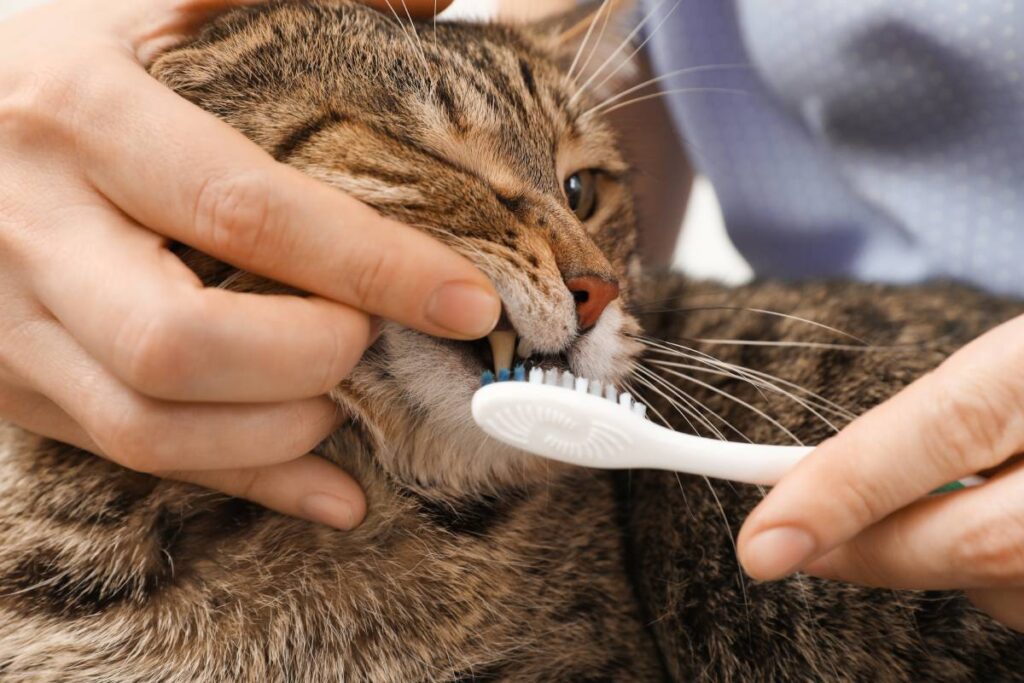
Healthy feline gums are pale pink and tight against the tooth; a red band along the margin signals gingivitis.
Credit: weareallaboutcats.com
| Method | How it helps | Honest limitation |
|---|---|---|
| Dental wipes | Physically remove surface plaque | No sub-gingival access; daily use needed |
| Enzymatic oral gels | Chemically slow plaque formation | No mechanical scrubbing |
| Dental diets (large, fibrous kibble) | Shears plaque as the tooth sinks in | Only affects the teeth doing the chewing |
| Dental treats / chews | Mild abrasion plus enzymes | Adds calories; must be portioned |
| Water additives | Reduce oral bacterial load | Some cats reject the taste and drink less |
| Chew toys with texture | Light mechanical cleaning | Highly variable engagement |
Textured wipe-based plaque control is the closest practical substitute for brushing, because it still involves physical contact with the tooth surface. Many owners find that single-use tooth wipes succeed with cats who refuse a brush handle entirely, and there's a broader set of no-brush cleaning routines worth trying before you give up on home care altogether.
A note on diet: dry food does not clean teeth in any meaningful way unless it's a purpose-built dental kibble with a fibre matrix. Standard small kibble shatters on contact. If you're weighing the kibble versus canned question, decide it on hydration, calorie control, and palatability — then handle dental care separately. Many owners feed a high-moisture wet diet for urinary and kidney reasons and simply brush alongside it.
Professional Dental Cleanings: What to Expect
Home brushing prevents disease; it doesn't reverse it. Once tartar is visible or the gums are inflamed, your cat needs a professional cleaning.
A proper veterinary dental (often called a COHAT — Comprehensive Oral Health Assessment and Treatment) includes:
- Pre-anaesthetic bloodwork and, in older cats, blood pressure and sometimes cardiac screening.
- General anaesthesia with intubation — non-anaesthetic "scaling" cannot clean below the gum line and does not allow radiographs.
- Full-mouth dental X-rays, which are non-negotiable in cats. Resorptive lesions and root pathology are frequently invisible above the gum line.
- Ultrasonic scaling above and below the gum, probing of every tooth, and polishing.
- Extractions where indicated, with local nerve blocks and take-home pain relief.
Ask your practice two specific questions when booking: Do you take full-mouth radiographs as standard? and Is a dedicated nurse monitoring anaesthesia throughout? The answers tell you a great deal about the quality of care.
Frequency varies enormously by individual. Some cats need a cleaning every year; some go five years between them. Brushing consistently is what pushes you toward the longer interval — and it lowers lifetime cost considerably.
Special Situations
Kittens
Start at 10–14 weeks, during the socialisation window. A kitten who has had their lip lifted daily since kittenhood usually accepts brushing for life. Note that kittens lose baby teeth from roughly 3–6 months; a little mild gum redness and mild bleeding is normal then, but be gentle and pause if a tooth is loose.
Senior cats
Older cats need more dental attention, not less. Age itself is not a contraindication to anaesthesia — untreated infection and chronic pain are the bigger risks. If your cat has renal disease, discuss fluid support around the procedure, and coordinate dental planning with the rest of the management plan, including any renal-support formula they're on.
Cats with existing pain
Never brush an actively inflamed, ulcerated mouth. Get the pain treated first, then rebuild the habit once the tissue has healed.
Multi-cat households
Brush cats separately, in a quiet room, and use each cat's own brush — sharing spreads bacteria and, in some cases, viral disease. Keeping the wider environment low-stress helps too; competition at resources like feeding stations and the litter tray setup raises baseline tension, and a tense cat is a harder cat to handle.
Flat-faced breeds
Persians, Himalayans, and other brachycephalic cats have crowded, rotated teeth and accumulate plaque quickly. They usually need daily brushing plus earlier professional intervention. These breeds also benefit from other routine facial care such as tear-stain cleaning pads alongside the dental routine.
Common Myths, Debunked

Pet-formulated toothpaste is safe to swallow — cats cannot rinse and spit, so this matters.
Credit: www.purina.com
"Cats clean their own teeth by grooming." They don't. Grooming addresses the coat, not the tooth surface. If anything, dander- and coat-wiping products belong to an entirely separate part of the routine.
"Cat breath is supposed to smell." Healthy feline breath is fairly neutral. A strong, rotting, or metallic odour is bacterial and warrants examination.
"Wild cats don't brush and they're fine." Wild felids gnaw bone, hide, and connective tissue that scrapes teeth — and they have shorter lifespans, with dental disease among the reasons. It isn't a model to copy.
"Dry food is a toothbrush." Only specific dental formulations offer meaningful abrasion, and even then only on the chewing teeth. If nutrition is your focus, judge food on its overall nutritional profile, not on dental claims.
"Old cats can't handle a dental." Modern protocols with pre-anaesthetic screening, IV fluids, heat support, and continuous monitoring make anaesthesia far safer than leaving abscessed teeth in place.
"Anaesthesia-free cleaning is a safer alternative." It removes visible tartar cosmetically while leaving the disease below the gum line untouched — and it can't take radiographs. It is not equivalent care.
Mistakes Owners Make Most Often
- Starting with a full brushing attempt. One bad session teaches avoidance faster than ten good ones undo it.
- Scruffing or wrapping the cat in a towel by default. Restraint should be a last resort, not step one.
- Brushing only the front teeth because they're easiest to reach. The back upper premolars carry the highest disease burden.
- Trying to brush the inner surfaces. The tongue keeps them relatively clean, and the attempt risks a bite. Outer surfaces only.
- Giving up after a week. Two to four weeks of consistent, tiny sessions is the normal timeline.
- Using treats with no portion control, then wondering why the cat gained weight. Deduct dental treats from the daily calorie budget.
- Treating brushing as a substitute for veterinary dentals. They're complementary, not interchangeable.
If handling of any kind is a battle, building general tolerance helps — many owners have better luck with dental sessions after their cat has become comfortable with routine handling through a professional grooming service or gradual at-home conditioning.
Frequently Asked Questions
Do cats really need their teeth brushed?
Yes. Cats cannot clean their own teeth, and plaque begins mineralising into tartar within days. Brushing is the only home method that mechanically removes plaque at the gum line before it hardens. Daily is ideal; two to three times a week is the practical minimum for a measurable effect.
What happens if you never brush your cat's teeth?
Plaque hardens into tartar, gums become inflamed, and periodontal disease sets in — destroying the bone and ligament that hold teeth in place. The result is chronic pain, possible tooth resorption and abscesses, and extractions under anaesthesia. Most cats keep eating throughout, which is exactly why it goes unnoticed until it's advanced.
Can I use human toothpaste on my cat?
No. Human toothpaste contains fluoride, detergents, and sometimes xylitol, all of which are unsafe for a cat to swallow — and cats cannot spit. Use an enzymatic paste made for pets. Plain water on a soft brush is still better than nothing while you source the right product.
At what age should I start brushing?
Ideally around 10–14 weeks, as part of general handling socialisation. That said, adult and senior cats can absolutely be trained — it just takes a longer desensitisation period. There's no age at which it becomes pointless.
How long should a brushing session take?
About 30 seconds once you're established: roughly 15 seconds per side, focusing on the outer surfaces along the gum line, with the back upper teeth included. During training, 5–15 seconds is plenty.
My cat bites when I try. What now?
Stop and drop back several stages. Rebuild with finger-only touching and paste as a treat for a week, and try again outside mealtimes when they're sleepy. If aggression persists, switch to wipes, gels, and VOHC-accepted dental products, and increase the frequency of professional cleanings. A cat who cannot be brushed still deserves a dental plan — just a different one.
Do dental treats replace brushing?
No, but they help. Think of them as a supplement that slows plaque accumulation between brushings, not a replacement for mechanical cleaning.
The Bottom Line
Brushing your cat's teeth is genuinely worth doing, and it's more achievable than most owners expect. The formula is simple: a soft small-headed brush, a pet-safe enzymatic paste in a flavour your cat likes, 30 seconds a day on the outer surfaces at a 45-degree angle to the gum line, and a reward every single time. Build up over two to four weeks rather than forcing it in one sitting.
Pair that with an annual veterinary oral exam, full-mouth radiographs when a cleaning is performed, and VOHC-accepted products as backup — and you'll spare your cat years of hidden pain while cutting down on expensive extractions later.
Start small tonight: lift one lip, touch one tooth with your fingertip, and give a treat. That's day one. In three weeks, you'll have a brushing routine — and a cat who's noticeably more comfortable for it.