
Cat owners rarely notice dental trouble until the breath turns sour or a cat starts dropping kibble from one side of its mouth. By then, plaque has usually hardened into tartar and the gum line is already inflamed. Vibrant Life Plaque Tooth Wipes — the Walmart-exclusive dental wipe most cat owners search for by name — exist to catch that problem earlier, using a textured, pre-moistened pad you slip over a fingertip and rub along the outer tooth surfaces.
This guide covers what these wipes realistically do (and don't do), how to use them on a cat that would rather bite than cooperate, how they compare with the widely available finger-wipe alternatives on the market in 2026, and how to fold them into a home dental routine that actually prevents disease rather than just masking odour.
What Vibrant Life Plaque Tooth Wipes Actually Are
Vibrant Life is Walmart's house pet-care brand, and its plaque tooth wipes follow the standard format used across the category:
| Feature | Typical specification |
|---|---|
| Format | Pre-moistened, disposable finger wipe |
| Texture | Lightly embossed or ribbed cleaning surface |
| Rinsing | Not required — no water, no toothpaste |
| Count | Usually 30–50 wipes per resealable tub or pouch |
| Species | Labelled for cats; most competitor versions cover cats and dogs |
| Scent | Mild or unscented, depending on the run |
| Cost per use | Roughly a few cents per wipe |
The mechanism is simple and mechanical. Plaque is a soft, sticky biofilm of bacteria and salivary proteins that begins re-forming on a clean tooth within hours. While it is still soft, it can be physically rubbed away. That is exactly what a textured wipe does — it abrades the biofilm off the enamel and massages the gum margin, while the damp pad carries the debris away.
The honest limitation: once plaque mineralises into tartar (calculus), no wipe on the market will remove it. Tartar bonds to enamel and has to be scaled off under anaesthesia by a veterinarian. Product marketing that promises "tartar removal" is describing prevention of new tartar, not dissolution of existing deposits. In practice, if you can see brown or yellow crust at the gum line, wipes are a maintenance tool for after a professional cleaning — not a substitute for one.
Why Feline Oral Care Deserves More Attention Than It Gets
Periodontal disease is the most commonly diagnosed condition in adult cats, and veterinary dental specialists consistently report that the majority of cats show some degree of it by three years of age. The progression is predictable:
- Plaque forms on the tooth surface within 24 hours of cleaning.
- Gingivitis develops as bacteria irritate the gum margin — red, slightly swollen edges, sometimes a faint bleed when touched.
- Tartar mineralises from plaque in as little as two to three days in some cats, creating a rough surface that collects more plaque.
- Periodontitis sets in as inflammation destroys the ligament and bone anchoring the tooth. This stage is painful and irreversible.
Cats are exceptionally good at hiding oral pain. They rarely stop eating outright; they simply chew on one side, swallow kibble whole, groom less thoroughly, or become subtly withdrawn. The American Veterinary Medical Association recommends regular oral examinations as part of routine preventive care precisely because owners so seldom catch the early signs at home.
Feline-specific complications make this worse. Tooth resorption — where the tooth structure is broken down by the body itself — affects a large share of adult cats and is often invisible until a lesion reaches the gum line. Stomatitis, a severe immune-driven inflammation of the mouth, is another feline problem that no home product will fix. Wipes prevent plaque; they do not treat disease. Knowing that distinction is what separates a useful routine from false reassurance.
How to Use a Dental Wipe on a Cat That Objects
This is where most owners fail, and it has nothing to do with the product. A cat that has had a finger jammed into its mouth once will remember it for months. The fix is desensitisation, not force.
A realistic 10-day introduction plan
Days 1–3 — Touch only.
Sit beside your cat while it is relaxed (after a meal is ideal). Stroke the muzzle and lift the lip for one second. Release, reward, stop. Total time: under 15 seconds.
Days 4–6 — Dry finger.
Run a bare fingertip along the outer surface of the upper canines and the large upper premolars. Two seconds per side. Reward immediately.
Days 7–8 — Wipe, one quadrant.
Wrap the wipe over your index finger. Clean the upper right cheek teeth only. Stop even if the cat seems fine — ending early is what builds tolerance.
Days 9–10 — Full pass.
Work all four quadrants, upper teeth first, in roughly 30–45 seconds total.
The technique that actually works
- Approach from the side, never head-on. Coming at a cat's face frontally triggers a defensive response.
- Support the head from above with your non-dominant hand, thumb and middle finger resting on the cheekbones. You are stabilising, not restraining.
- Do not try to open the mouth. The inner (tongue-side) surfaces of feline teeth stay relatively clean thanks to the tongue and saliva. Plaque accumulates on the outer (cheek-side) surfaces, which you can reach with the mouth closed.
- Focus on the gum line, using small circular strokes along the junction of tooth and gum — that is where periodontal disease begins.
- Prioritise the big four: the upper canines and the upper fourth premolars (the large carnassial teeth toward the back). These accumulate the most tartar.
- Finish with something good. A high-value reward after each session builds a positive association fast; the same principle behind small food rewards in any training programme applies here.
A common mistake is treating the session as a chore to be endured. If your cat associates the wipe with being pinned, you will lose the routine within a fortnight. Owners who have worked through gentle handling exercises with their cats typically get a compliant patient inside two weeks. If you already use marker-based reward training, mark the instant the wipe touches the tooth — the timing does most of the work for you.
How often?
Plaque re-forms within 24 hours, so daily is the gold standard. Realistically, three to four sessions a week delivers most of the benefit; anything less than twice weekly has limited preventive value. Consistency beats duration every single time.
What to Look for When Buying Cat Dental Wipes
If Vibrant Life wipes are out of stock locally — or you want to compare before committing — judge alternatives on these points rather than on packaging claims.
1. Texture over saturation. The abrasive action does the cleaning. Wipes that are soaking wet feel effective but slide over plaque without shifting it. A slightly damp, ribbed pad works better.
2. Fit on the finger. Cat mouths are small. A wipe sized for a Labrador bunches up and gets bitten. Look for pads that fold neatly to roughly the width of an adult index finger, or products explicitly sized for cats.
3. Ingredient transparency. Reasonable inclusions are purified water, glycerin, mild surfactants, aloe, baking soda, and occasionally chlorhexidine at low concentration. Avoid xylitol (dangerous to dogs and unnecessary in any pet product), alcohol, and strong artificial fragrances. Cats have a sharp sense of smell and reject heavily perfumed products.
4. Lick-safe formulation. Your cat will swallow whatever is left behind. Any wipe intended for oral use must be safe to ingest in small residual amounts.
5. Packaging seal. A tub with a poor lid dries out within weeks and you waste half the pack. Resealable lids beat foil-flap pouches.
6. VOHC acceptance, where available. The Veterinary Oral Health Council awards a seal to products that meet defined standards for reducing plaque or tartar in controlled trials. Few wipes carry it — most accepted feline products are diets, treats, gels and water additives — but the VOHC list is the single most useful reference when you want proof rather than marketing.
Ten Alternatives Worth Comparing
Below are widely available finger-wipe options, with realistic assessments of where each fits. All use the same basic mechanism as the Vibrant Life wipes; the differences lie in size, texture, scent and pack economics.
Quick comparison
| Product | Count | Scent | Best suited to |
|---|---|---|---|
| HICC PET Teeth Cleaning Wipes | 50 | Mild | Owners starting from zero |
| MEDUWEDU Dental Care Finger Wipes | 60 | Coconut | Best value per wipe |
| No-Rinse Dog Dental Care Wipes (BuddyCheer) | 50 | Unscented | Scent-sensitive cats |
| Petstoral Dental Care Wipes | 50 | Mild | Multi-pet households |
| PITHER Dog Teeth Cleaning Wipes | 50 | Mild | Cats with tender gums |
| Paw Science Dental Finger Wipes | 50 | Fresh | Owners wanting a kit |
| PawSono Dental Finger Wipes | 50 | Unscented | Fussy, reactive cats |
| SmileDenX Finger Wipes | 50 | Unscented | Travel and boarding |
| LEAGIM Plant-Based Wipes | 50 | Unscented | Natural-ingredient buyers |
| RunyePet Pet Dental Finger Wipes | 50 | Mild | Everyday maintenance |
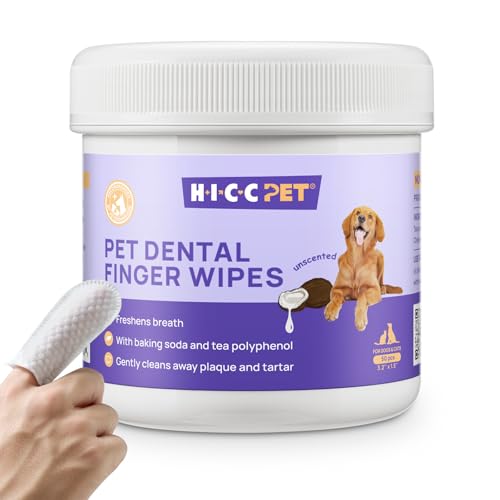
1. HICC PET Teeth Cleaning Wipes for Dogs & Cats

HICC's 50-count tub is one of the more established finger-wipe options for households with both cats and dogs.
A sensible entry point for owners who have never attempted home dental care. The pad is firm enough to give real mechanical friction, and the no-rinse formula means the whole session ends the moment you pull your hand away — no chasing a wet cat around the kitchen.
Strengths
- Sturdy texture that genuinely disrupts soft plaque rather than smearing it
- 50 disposable wipes, so no cross-contamination between pets
- Compact tub (under 3 inches per side, around 0.33 lb) that lives easily in a drawer
- Works for both cats and dogs in mixed households
Trade-offs
- Sized generously for dogs — you may need to fold it twice for a small cat
- Will not remove established tartar; that still requires a veterinary scaling
Verdict: the most forgiving wipe for a first attempt, because the extra body makes it easy to keep the pad on your finger while your cat wriggles.
👉 Check current pricing on the 50-count HICC tub and start a routine this week rather than after the next vet bill.
2. MEDUWEDU Dental Care Finger Wipes (60 Count)

Sixty wipes per tub makes this one of the cheapest per-session options for daily users.
The 60-count pack gives roughly two months of daily use for a single cat, which is the best value on this list. The coconut scent is genuinely mild rather than perfumed, and it neutralises odour better than the unscented options.
Strengths
- Highest wipe count here — best cost per session
- Gentle formula suited to cats with slightly inflamed gum margins
- Light coconut note that masks odour without overpowering
- Travel-friendly tub
Trade-offs
- Any added scent is a gamble with a scent-sensitive cat; test one wipe first
- Not a fix for advanced periodontal disease
Verdict: the pick if you are committing to daily cleaning and want to keep running costs down.
👉 Get the 60-count MEDUWEDU pack — two months of daily dental care for roughly the price of one dental treat bag.
3. No-Rinse Dog Dental Care Wipes by BuddyCheer

The unscented formulation is aimed at pets that reject flavoured or perfumed dental products.
Completely unscented, which matters more for cats than most buyers realise. Cats evaluate anything approaching their face by smell first, and a neutral wipe removes one of the main reasons for refusal.
Strengths
- No fragrance at all — the highest acceptance rate among suspicious cats
- Finger-sleeve construction gives good tactile feedback along the gum line
- Disposable and hygienic, with no shared-brush bacterial transfer
- Compact 3 x 3 x 3 inch tub
Trade-offs
- No flavour means no incentive for the cat to tolerate the process — rely on rewards instead
- 50 wipes goes quickly in a multi-pet home
Verdict: the safest choice for a cat that has already refused a scented product.
👉 View the unscented BuddyCheer wipes if fragrance has been the sticking point so far.
4. Petstoral Dental Care Wipes for Dogs and Cats

A slim 3.4 x 1.5 inch pack that fits in a jacket pocket or travel bag.
Petstoral's format leans toward gum care as much as tooth surface, with a softer pad that suits cats showing early gingival redness. The narrow packaging is the most portable on this list.
Strengths
- Soft enough for tender gum margins while still textured
- Slim, pocketable packaging
- Works across cats and dogs of any size
- 50 wipes per pack
Trade-offs
- The softer pad requires a few extra strokes on heavy plaque
- Reseal the pack properly or the remaining wipes dry out
Verdict: a good option for older cats or any mouth that looks slightly inflamed at the gum line.
👉 Check availability of the Petstoral 50-count pack for a gentler start with a sensitive mouth.
5. PITHER Dog Teeth Cleaning Wipes

The finger-sleeve shape is designed to reach the rear premolars, where tartar builds fastest.
PITHER's wipe holds its shape well on the finger, which is the difference between reaching the back teeth and giving up halfway. At roughly 0.35 lb per pack it is barely heavier than the alternatives despite the sturdier pad.
Strengths
- Retains its form on the finger instead of bunching
- Reaches the upper fourth premolars — the highest-tartar teeth
- Safe for daily use on both species
- 50-count supply
Trade-offs
- Still no replacement for scheduled professional cleanings
- Some cats need a fortnight of gradual exposure before tolerating rear-tooth access
Verdict: the best-shaped wipe here for reaching the back of the mouth.
👉 Look at the PITHER finger wipes if the back teeth are where your cat's tartar keeps returning.
6. Paw Science Dental Finger Wipes for Cats & Dogs

Sold as a kit, pairing disposable wipes with a reusable finger brush.
The included finger brush is the differentiator. Many owners find wipes are the right tool for the first month and a brush becomes viable once the cat is comfortable — this kit lets you make that transition without a second purchase.
Strengths
- Wipes plus a reusable finger brush in one purchase
- Soft pad that lifts food debris as well as plaque
- Clean, light scent
- Portable enough for travel or boarding
Trade-offs
- Surface cleaning only; subgingival pockets are beyond any home tool
- Some cats reject the rigid brush even after accepting the wipes
Verdict: buy this if you intend to progress toward proper brushing rather than staying on wipes indefinitely.
👉 See what's included in the Paw Science kit and give yourself an upgrade path.
7. PawSono Dog Teeth Cleaning Wipes (Unscented, 50 PCS)

Explicitly labelled lick-safe, which matters because cats swallow whatever residue is left behind.
PawSono leans into the two features cats care about most: no smell and a lick-safe formula. The textured surface is on the finer side, which suits cats that flinch at anything coarse.
Strengths
- Lick-safe formulation for residue a cat will inevitably swallow
- Zero fragrance for scent-averse animals
- Fine texture that avoids irritating sore gums
- 50 wipes per pack
Trade-offs
- Finer texture means slower work on heavier plaque
- Initial resistance is still normal for the first week
Verdict: the choice for the most reactive cats, where acceptance matters more than raw scrubbing power.
👉 Try the unscented PawSono wipes with a cat that has refused everything else.
8. SmileDenX Dog Dental Care Finger Wipes

At 2.95 inches square, the tub fits inside most carriers alongside food and medication.
Straightforward, unscented and compact. The small footprint makes this the practical pick for boarding stays, road trips or a carrier's side pocket, where routines are most likely to slip.
Strengths
- Genuinely small packaging — 2.95 x 2.95 x 2.95 inches
- Unscented, low-rejection formula
- Textured surface effective on soft plaque and food debris
- 50 wipes per tub
Trade-offs
- Not a substitute for a veterinary dental procedure
- Cats new to oral handling still need a gradual introduction
Verdict: keep one tub at home and one in the carrier so travel never breaks the habit.
👉 Add the compact SmileDenX tub to your travel kit and keep the routine going away from home.
9. LEAGIM Plant-Based Dog Teeth Cleaning Wipes

Plant-derived ingredients with an included finger brush, aimed at owners avoiding synthetic additives.
LEAGIM's plant-based positioning appeals to owners who scrutinise ingredient lists. The unscented formula and included finger brush make it a reasonable all-in-one starter pack.
Strengths
- Plant-derived cleaning ingredients, no strong synthetic fragrance
- Includes a finger toothbrush alongside the wipes
- Unscented and non-irritating
- 50 wipes per pack
Trade-offs
- "Plant-based" is a marketing descriptor, not a regulated efficacy claim — judge it on texture and acceptance
- Results depend entirely on consistent use
Verdict: a solid natural-leaning option, provided you treat the ingredient story as a preference rather than a performance guarantee.
👉 Compare the LEAGIM plant-based kit if you prefer a simpler ingredient list.
10. RunyePet Pet Dental Finger Wipes

A no-rinse wipe built around gum-margin cleaning as much as tooth-surface work.
RunyePet's wipe slides on easily and is soft enough for daily use on cats with mild gingivitis, while still providing enough friction to be worth the effort.
Strengths
- Comfortable slide-on fit for controlled gum-line contact
- No rinsing, no water, no second step
- Disposable design prevents bacterial carry-over between sessions
- 50 wipes for good everyday value
Trade-offs
- Surface cleaning only — subgingival plaque is beyond reach
- Expect a settling-in period with a cat new to mouth handling
Verdict: a dependable everyday maintenance wipe with nothing unusual to trip you up.
👉 Check the RunyePet 50-count pack and make daily dental care a 45-second habit.
Building a Complete Home Dental Routine
Wipes are one layer of defence. Cats whose owners stack two or three approaches consistently outperform those relying on a single product.
Diet
Texture matters less than most people assume — standard dry kibble shatters on contact and provides negligible abrasion. What matters more is overall nutritional quality and, for cats prone to urinary or kidney issues, moisture content. A moisture-rich feeding approach supports hydration and saliva production, which helps flush oral bacteria. If you are reviewing your cat's diet more broadly, start with what genuinely constitutes balanced nutrition before chasing dental-specific claims. Purpose-built dental diets with enlarged, fibre-aligned kibble do work, but only when fed as the primary food.
VOHC-accepted adjuncts
Water additives, dental gels and accepted dental treats are the easiest wins for cats that will not tolerate handling at all. Check the VOHC accepted-product list rather than package copy.
Weekly mouth check
Once a week, lift the lip on both sides in good light and look for:
- Red or swollen gum margins
- Yellow-brown crust at the gum line
- Missing, chipped or discoloured teeth
- Pink tissue growing onto a tooth surface (a classic resorption sign)
- Ulcers or bright-red inflammation at the back of the mouth
Photograph what you see monthly. Comparing images over time reveals changes you would otherwise miss.
Professional cleanings
Plan for a veterinary dental assessment at least annually, and a full cleaning under anaesthesia when your vet advises it. So-called "anaesthesia-free dental cleaning" only polishes the visible crown; it cannot address the area beneath the gum line where disease actually occurs, and most veterinary dental authorities advise against it.
Fit it into your grooming rhythm
Dental care sticks best when it is bundled with grooming your cat already accepts. Owners who use coat-care cloths or tear-stain cleaning pads will find the mouth is a natural third stop on the same two-minute circuit. For cats that resist all handling, a session with an experienced grooming professional can normalise being touched around the face before you try again at home.
Five Mistakes That Undermine Dental Wipes
- Starting when the mouth already hurts. Wiping inflamed, painful gums teaches a cat that the wipe equals pain. Get a veterinary exam first if you see redness, drooling or reluctance to chew.
- Chasing existing tartar. Scrubbing harder will not lift mineralised calculus — it just makes the gums sore. Get a cleaning, then use wipes to keep the teeth clean afterwards.
- Being inconsistent. Two enthusiastic weeks followed by a month off achieves almost nothing. Plaque cycles in 24-hour windows.
- Doing too much per session. Thirty seconds daily beats three minutes once a week, both mechanically and behaviourally.
- Reusing a wipe across pets. Disposable means disposable — one wipe, one mouth, one session.
When to Stop Wiping and Call the Vet
Book an appointment promptly if you notice:
- Persistent bad breath that does not improve after two to three weeks of consistent cleaning
- Drooling, especially if blood-tinged
- Pawing at the mouth or head-shaking while eating
- Dropping food, chewing on one side, or approaching food then backing away
- Visible gum recession, a loose tooth, or a lump on the gum
- Sudden weight loss or a decline in grooming
These are not problems a wipe can solve. They warrant a full oral examination, usually with dental radiographs, because a substantial share of feline dental disease — resorptive lesions in particular — is only visible on X-ray.
Frequently Asked Questions
What exactly are Vibrant Life Plaque Tooth Wipes for cats?
They are disposable, pre-moistened textured pads sold under Walmart's Vibrant Life pet-care brand, designed to be wrapped around a fingertip and rubbed along a cat's outer tooth surfaces. They require no water, no rinsing and no toothpaste, and they work by mechanically disrupting soft plaque before it mineralises into tartar.
Do dental wipes really remove tartar?
They remove plaque, not tartar. Plaque is a soft biofilm that responds to physical friction; tartar is mineralised and bonded to enamel, and only a veterinary scaler will shift it. Wipes prevent new tartar forming — which is the point — but they cannot reverse deposits that are already there.
Are these wipes safe for cats to swallow?
Products formulated for oral use are made to be safe in the small residual amounts a cat will inevitably lick off. Confirm the label says "lick-safe" or "no rinsing required," avoid anything containing xylitol or alcohol, and never substitute a general-purpose pet grooming wipe or a human baby wipe for a dental product.
How often should I use them?
Daily is ideal, because plaque begins re-forming within 24 hours. Three to four sessions a week captures most of the benefit. Below twice weekly, the preventive effect drops off sharply.
Will wipes fix my cat's bad breath?
Often, yes — if the odour comes from ordinary plaque bacteria. Expect improvement within one to two weeks of consistent use. Breath that stays foul despite regular cleaning suggests something a wipe cannot reach: periodontal pockets, a resorptive lesion, stomatitis, or occasionally a kidney or metabolic issue. That is a veterinary conversation.
At what age can I start?
You can begin gentle mouth handling with kittens as soon as they are settled in your home, using a dry finger first and moving to wipes once they are relaxed about it. Kittens introduced early usually accept lifelong dental care without a fight — it is far easier than retraining a seven-year-old cat.
Can I use dog dental wipes on my cat?
Most finger wipes are dual-species labelled and are chemically fine for cats. The practical issue is size: a wipe cut for a large dog bunches up in a cat's much smaller mouth. Fold it down, or choose a smaller-format product.
Do wipes replace professional cleanings?
No. Home care controls plaque above the gum line. Disease develops below it, in the periodontal pocket, where no wipe reaches. Think of wipes as the thing that lengthens the interval between professional cleanings, not the thing that eliminates them.
My cat absolutely will not tolerate a wipe. What now?
Fall back to VOHC-accepted water additives, dental gels applied to the gum line, or dental treats and diets — all of which require no restraint at all. Then restart desensitisation in tiny increments: touch the muzzle, reward, stop. Weeks of two-second sessions beat one forced attempt.
The Bottom Line
Vibrant Life Plaque Tooth Wipes solve a real problem: most cat owners will never manage a full toothbrushing routine, and doing nothing guarantees periodontal disease. A textured finger wipe used for 30–45 seconds most days disrupts plaque before it hardens, keeps the gum line healthier, and makes the annual veterinary dental exam considerably less alarming.
Be clear-eyed about the limits. Wipes clean the outer tooth surfaces only. They will not dissolve tartar, treat resorptive lesions, or fix stomatitis. What they will do — and this is the whole value — is buy your cat cleaner teeth, less inflammation, and fewer painful extractions over a lifetime.
Your next three steps:
- Do a lip-lift check tonight and note what you see at the gum line.
- Pick one wipe from the comparison above and commit to 10 days of short, reward-backed sessions.
- Book a veterinary oral exam if you spot anything beyond mild plaque.
Ready to start? Pick the wipe that best matches your cat's temperament from the options above, keep the tub somewhere you will actually see it — beside the food bowl works — and give your cat a mouth that stays comfortable well into old age.