
Short answer: yes — plain, unsweetened freeze-dried strawberries are not toxic to cats, and a tiny piece now and then is very unlikely to hurt a healthy adult cat. But they offer almost nothing your cat actually needs, and the sugar is far more concentrated than in fresh fruit. For most households, the honest verdict is "safe but pointless" — with a few specific cats who should skip them entirely.
Below is the full picture: what freeze-drying actually does to a strawberry, how the numbers stack up against a cat's daily calorie budget, which label ingredients are genuinely dangerous, exact portion guidance by body weight, and what to reach for instead.
What Freeze-Dried Strawberries Actually Are
Freeze-drying (lyophilisation) is not the same as dehydrating or baking. The fruit is frozen solid, then placed under a deep vacuum so the ice sublimates — turning straight from ice to vapour without ever becoming liquid. Roughly 90–97% of the water leaves, but the cell structure stays largely intact, which is why the slices keep their shape and shatter into that airy crunch.
Two consequences matter for cats:
- Everything else gets concentrated. Remove the water and what remains is mostly sugar and fibre, by weight. Gram for gram, a freeze-dried strawberry is dramatically sweeter than a fresh one.
- It's hygroscopic. Freeze-dried fruit pulls moisture back in aggressively — including from saliva and the gut. In practice, that's why a cat who wolfs down a handful is more likely to get an upset stomach than one who licks a crumb.
A common mistake is assuming "freeze-dried" is automatically healthy because it's the same technology used for premium freeze-dried raw meat treats. The process is neutral; what's inside the bag is what counts. Freeze-dried chicken hearts and freeze-dried strawberries have almost nothing in common nutritionally.
Nutritional Profile: The Numbers That Matter
Here's the rough picture, using standard values for strawberries before and after freeze-drying. Treat these as close approximations — moisture removal varies by brand.
| Per 100 g | Fresh strawberries | Freeze-dried strawberries |
|---|---|---|
| Calories | ~32 kcal | ~350 kcal |
| Sugars | ~5 g | ~50 g |
| Fibre | ~2 g | ~20 g |
| Water | ~91% | ~3% |
| Protein | ~0.7 g | ~7 g |
| Taurine | 0 | 0 |
That last row is the one cat owners should sit with. Strawberries contain zero taurine, zero arachidonic acid, zero preformed vitamin A and zero vitamin B12 — the nutrients cats cannot synthesise adequately and must eat. Fruit is not a supplement for a cat. It's a novelty.
Vitamins and minerals
Fresh strawberries are genuinely rich in vitamin C, manganese, folate and potassium, plus polyphenols like anthocyanins and ellagic acid. That's excellent news for humans. Cats, however, synthesise their own vitamin C in the liver and don't need a dietary source — so the headline benefit of strawberries simply doesn't apply. Some of the vitamin C is also lost during processing and storage.
The antioxidant argument is similarly weak in practice. The polyphenol dose in a crumb-sized piece of freeze-dried fruit is negligible, and there's no evidence it does anything measurable for a cat. If you want real nutritional leverage, it comes from the base diet, not the treat jar — which is exactly why choosing complete-and-balanced formulas matters far more than any fruit topper.
Calories and the 10% rule
Veterinary nutrition guidance is consistent: treats should contribute no more than 10% of daily calories, with the other 90% coming from a complete, balanced diet.
- A typical 10 lb (4.5 kg) indoor adult cat needs roughly 180–220 kcal per day.
- That gives a treat allowance of about 18–22 kcal.
- One thin freeze-dried strawberry slice weighs roughly 0.3–0.5 g, or about 1–2 kcal.
So a slice or two won't blow the budget. But cats are small, and calorie creep is real: three "harmless" snacks a day from three different family members is how a 10 lb cat quietly becomes a 13 lb cat. If more than one person feeds your cat, agree a daily treat count out loud.
Sugar: the real sticking point
Cats are the classic example of a species with a non-functional sweet taste receptor — the Tas1r2 gene is a pseudogene in felids. Your cat physically cannot taste sweetness the way you do. Whatever draws her to a freeze-dried strawberry, it's the crunch, the smell, or the fact that you're eating it — not the sugar.
Meanwhile, feline metabolism is built for protein and fat, with limited hepatic glucokinase activity for handling large carbohydrate loads. A 50%-sugar snack is about as far from an obligate carnivore's evolutionary diet as you can get. It won't cause diabetes from one slice, but there is no upside to normalising sugary snacks for a cat.
Why Cats and Fruit Are a Poor Match
Cats are obligate carnivores — a term worth using precisely. It doesn't just mean "they like meat." It means their physiology depends on nutrients found in animal tissue:
- Taurine — deficiency causes dilated cardiomyopathy and central retinal degeneration.
- Arachidonic acid — cats can't efficiently convert linoleic acid into it.
- Preformed vitamin A (retinol) — cats can't convert beta-carotene from plants.
- Vitamin B12 and niacin — required in higher dietary amounts than in omnivores.
Add a short digestive tract, low amylase activity and few sugar-splitting brush-border enzymes, and you have an animal poorly equipped to extract value from fruit. That's the biological reason fruit sits in the "harmless novelty" column rather than the "healthy addition" column — and it's the same reason questions about sharing another pet's dinner come up so often with a clear answer: species-specific nutrition is not interchangeable.

Most cats investigate fruit with their nose, then walk away — curiosity, not appetite.
Credit: www.yahoo.com
The Real Risks (Ranked by How Likely They Are)
1. Additives on the label — the biggest danger by far
The strawberry isn't the problem. What's added to it can be.
Never give your cat freeze-dried fruit containing:
- Xylitol / birch sugar — a sugar alcohol used in "no sugar added" products. It is dangerously toxic to dogs; the feline data is thinner, but there is no reason to take the risk. Avoid categorically.
- Chocolate or yogurt coatings — theobromine and caffeine in chocolate are toxic to cats, and yogurt coatings are typically sugar, palm oil and milk solids.
- Added sugar, glucose syrup or fruit juice concentrate — common in "strawberry crisps" marketed as snacks.
- Mixed-fruit blends containing raisins, sultanas or grapes — grapes and raisins are linked to acute kidney injury in dogs and are treated as an avoid-at-all-costs food in cats too.
- Onion or garlic powder — appears in savoury freeze-dried medleys and causes Heinz-body haemolytic anaemia in cats.
- Artificial sweeteners, flavourings and colourings generally.
The only acceptable ingredient list is one word: strawberries. The U.S. Food and Drug Administration oversees pet food safety and maintains public advisories and recall notices worth checking if you're ever unsure about a product, and ingredient-definition standards for pet foods and treats are set through the Association of American Feed Control Officials.
2. Gastrointestinal upset
Freeze-dried fruit is fibre-dense and moisture-free. Too much, too fast, and you may see soft stool, loose stool, gas or vomiting within 6–24 hours. Cats with a history of IBD, food-responsive enteropathy or chronic soft stools are far more reactive — for them, even a crumb of a novel food can trigger a flare.
Practical tip: know your cat's normal. It's much easier to spot a change in stool consistency when you're scooping regularly, which is one underrated argument for a well-designed tray setup you actually check twice a day.
3. Choking and mouth irritation
Freeze-dried slices are brittle and shatter into sharp shards. Cats don't grind food with flat molars the way we do — they shear. A whole slice can be inhaled or lodge against the palate. Always crumble the piece to roughly the size of a kibble before offering it.
4. Allergy or intolerance
True food allergy in cats is most commonly protein-driven (beef, fish, chicken, dairy), so strawberry allergy is uncommon — but not impossible. Signs to watch for:
- Facial or ear itching, over-grooming, miliary dermatitis
- Head shaking, red or inflamed skin
- Vomiting or diarrhoea within a day
- Rarely: facial swelling, hives, laboured breathing — an emergency
5. Dental sugar exposure
Sticky, sugary residues sitting on the gumline aren't ideal for a species already prone to periodontal disease and tooth resorption. It's a minor risk from occasional exposure, but a real argument against making fruit a daily habit.
How Much Is Actually Safe? A Portion Guide
Assuming a healthy adult cat, plain unsweetened product, and no other treats that day:
| Cat weight | Approx. daily calories | 10% treat budget | Max freeze-dried strawberry |
|---|---|---|---|
| 6 lb / 2.7 kg | ~140 kcal | ~14 kcal | ½ small slice, crumbled |
| 8 lb / 3.6 kg | ~170 kcal | ~17 kcal | 1 small slice, crumbled |
| 10 lb / 4.5 kg | ~200 kcal | ~20 kcal | 1 slice, crumbled |
| 14 lb / 6.4 kg | ~250 kcal | ~25 kcal | 1–2 slices, crumbled |
Frequency: no more than once or twice a week. And remember — if the strawberry is the treat, it replaces the usual treat rather than joining it.
How to Introduce It Safely: A 5-Step Method
- Check the bag. One ingredient: strawberries. If the label lists anything else, put it back.
- Crumble, don't hand over a whole slice. Break a piece into 3–4 kibble-sized fragments and offer just one.
- Offer it on your palm or a saucer — not mixed into the meal. If you hide it in food and your cat reacts badly, you won't know whether the fruit or the meal caused it.
- Wait 24 hours before offering more. Watch appetite, energy, stool consistency and litter box frequency.
- Provide fresh water. Moisture-free treats plus a cat's naturally low thirst drive is a poor combination, which is part of the wider case for how kibble and canned meals compare when planning overall hydration.
In practice, the most common outcome is anticlimactic: the cat sniffs it, bats it across the floor, and loses interest. That's a perfectly good result — curiosity satisfied, calories unspent.
Cats That Should Skip Strawberries Entirely
Some cats have no margin for dietary experiments:
- Diabetic cats. A concentrated-sugar snack has no place in a low-carbohydrate management plan.
- Cats with chronic kidney disease. Potassium and phosphorus intake are actively managed, and off-plan foods can undermine therapeutic feeding. Stick with vet-guided renal-support recipes and clear the treat with your vet first.
- Cats on an elimination diet trial. A single novel ingredient invalidates weeks of work.
- Cats with IBD, pancreatitis or chronic vomiting.
- Kittens under 12 months. Their calorie budget belongs entirely to growth.
- Overweight cats. Every discretionary calorie counts.
- Cats with a history of urinary crystals or FIC, where hydration and diet consistency are the whole strategy.
If your cat falls into any of these groups, the answer isn't "a little bit" — it's "no, and here's a meat-based alternative instead."
Better Treat Options Your Cat Will Actually Want
Because cats can't taste sweetness, a meat treat will nearly always outperform fruit for enthusiasm and nutrition.
Species-appropriate treats
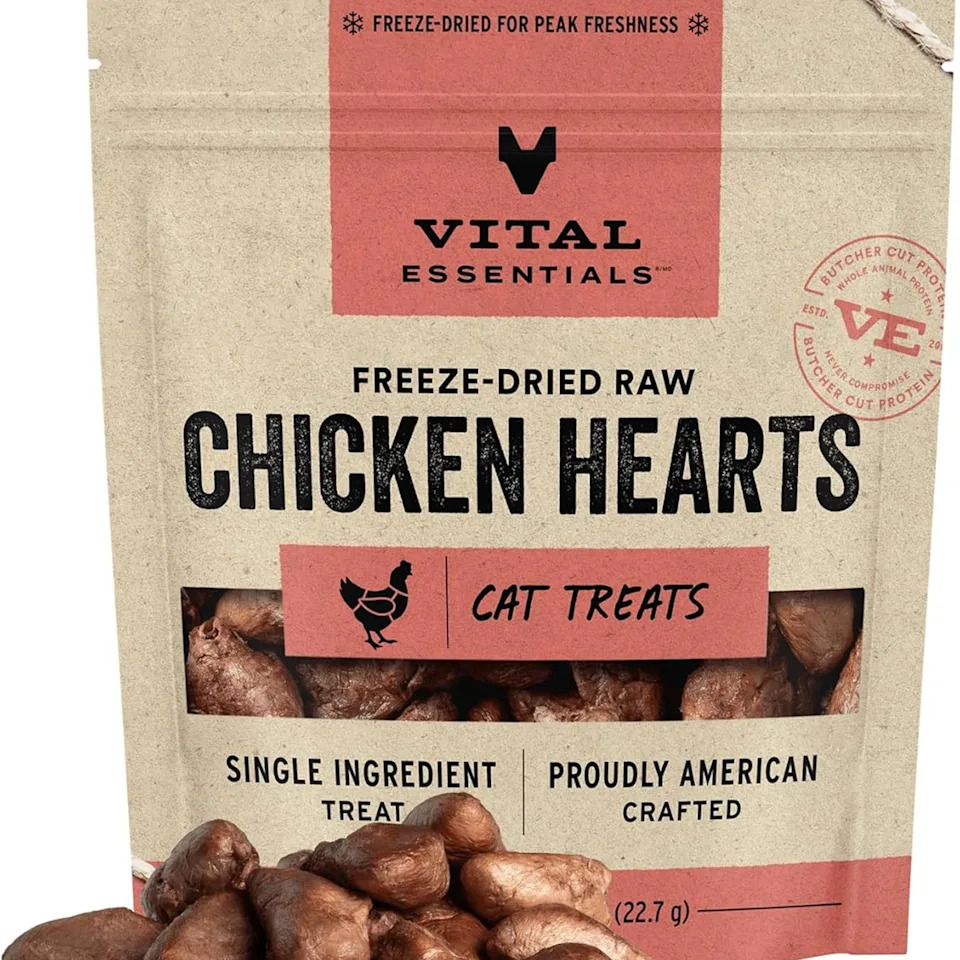
- Single-ingredient freeze-dried meat — chicken breast, turkey, rabbit, minnow, salmon. Same crunch, same shelf stability, but protein instead of sugar.
- Freeze-dried organ meat (heart, liver) — extremely high value for training; feed liver sparingly due to vitamin A.
- Air-dried or dehydrated fish skin for cats who like to chew.
- A spoonful of their own wet food, warmed slightly to release aroma — the cheapest high-value reward there is.
For everyday rewards, browsing options built for reward-based work will get you further than anything from the human snack aisle.
If you want to offer fruit anyway
Safe-in-tiny-amounts options include blueberries, seedless watermelon flesh, peeled apple (never the seeds or core), banana, and cantaloupe. Avoid grapes, raisins, citrus, cherries and any pits or stems.
Where the nutrition really comes from
No treat fixes a mediocre base diet. If you're rethinking your cat's food, start with the main meals — comparing higher-grade canned options and understanding how moisture-rich meals perform will do more for coat, weight and urinary health than any berry ever will. Small consistency upgrades like tightening up daily feeding routines or using scheduled portion dispensers tend to pay off faster than adding "superfoods."

Side by side, the contrast is obvious: one is a snack for you, one is a meal for her.
Credit: www.yahoo.com
Can You Use Freeze-Dried Strawberries as Training Rewards?
Technically yes — they're crunchy, low-calorie per piece, and easy to break small. Practically, no. Effective training rewards need to be high value, and a food a cat can't taste as sweet isn't high value. You'll get faster carrier training, harness acceptance or target-touch progress with a pea-sized piece of freeze-dried chicken.
If you're building a training routine, pair small meat rewards with a marker signal — a consistent marker device makes timing precise, and the broader principles behind teaching new behaviours apply whatever the treat. The same reward-timing logic is what makes it possible to redirect unwanted clawing in adult cats.
Next step: before your next shopping trip, flip over the freeze-dried fruit bag in your cupboard and read the ingredient panel. If it says anything beyond "strawberries," swap it for a single-ingredient freeze-dried meat treat — your cat will engage with it more and you'll remove every additive risk in one move.
Warning Signs: When to Call the Vet
Contact your veterinarian promptly if, after eating any freeze-dried fruit, your cat shows:
- Repeated vomiting or diarrhoea lasting more than 24 hours
- Refusal to eat for more than 24 hours (cats are at risk of hepatic lipidosis when they stop eating)
- Lethargy, hiding, or a hunched, painful posture
- Straining, gagging or pawing at the mouth
- Facial swelling, hives or any breathing difficulty — emergency
- Any known ingestion of xylitol, chocolate, grapes or raisins — emergency, do not wait for symptoms
Have the packaging with you or photographed. The ingredient panel is the first thing a vet or poison-control line will ask about.

The label check takes ten seconds and eliminates nearly every real risk.
Credit: www.instagram.com
The Professional Consensus
Veterinarians and board-certified veterinary nutritionists broadly agree on three points, and they haven't changed:
- Strawberries are non-toxic to cats. They do not appear on feline toxic-plant or toxic-food lists.
- They are nutritionally unnecessary. A complete and balanced diet already supplies everything a cat requires; fruit adds calories and sugar without filling a gap.
- The 10% treat ceiling applies to all extras, including "healthy" ones.
The honest trade-off: there's no compelling reason to say no to a crumb, and no compelling reason to say yes either. Where clinicians do push back firmly is on additive-laden products and on any cat with diabetes, kidney disease or gastrointestinal disease.
If your cat has a chronic condition, the right move isn't a web search — it's a two-minute question at your next appointment, ideally with the product photo on your phone.
Frequently Asked Questions
Are freeze-dried strawberries okay for cats?
Plain, unsweetened freeze-dried strawberries with no additives are safe for a healthy adult cat in very small amounts — roughly one crumbled slice, no more than once or twice a week. They provide no nutrients cats need and are high in concentrated sugar, so they should be treated as an occasional novelty, not a health food.
Can cats eat freeze-dried food generally?
Yes — freeze-dried food formulated for cats is a well-established category. Single-ingredient freeze-dried meat treats and complete freeze-dried raw diets can be excellent, provided the complete diets are labelled as nutritionally complete and balanced for the relevant life stage. Always rehydrate complete freeze-dried meals as directed and provide fresh water alongside.
Are fresh strawberries better than freeze-dried for cats?
For cats, fresh is marginally better: it contains water, and the sugars aren't concentrated. A small piece of fresh strawberry, stem and leaves removed and cut to kibble size, is a lower-risk choice than a dry, brittle, sugar-dense freeze-dried slice.
Why does my cat seem to love strawberries?
Almost certainly not the flavour — cats lack a functional sweet taste receptor. What attracts them is usually the crunchy texture, the aroma, the novelty, or simple social interest in whatever you're eating. Many cats also chase the slice as a toy rather than food.
Can kittens have freeze-dried strawberries?
Better not. Kittens have small calorie budgets that should go entirely toward growth, more sensitive digestive systems, and a higher choking risk with brittle pieces. Wait until adulthood, and even then keep it to a taste.
Are strawberry leaves or stems dangerous?
The green tops aren't classified as toxic, but they're fibrous, hard to chew and a genuine choking and obstruction risk. Remove them completely. The same goes for any woody stems in dried fruit mixes.
What about strawberry-flavoured cat treats or yogurt drops?
Skip them. "Strawberry flavour" in a pet product usually means added sugars, dairy solids and artificial flavouring — a combination with no benefit for an obligate carnivore, and one that many adult cats digest poorly due to reduced lactase activity.
The Bottom Line
Freeze-dried strawberries sit in an unusual category: safe, but not beneficial. They contain no taurine, no preformed vitamin A, no arachidonic acid — nothing a cat's body is asking for — and after freeze-drying, roughly half of what's left by weight is sugar. Cats can't even taste that sweetness.
So if your cat snatches a crumb off the counter, don't panic. Check the ingredient list for xylitol, chocolate coating, raisins or onion powder, watch for 24 hours, and carry on. But if you're choosing a treat deliberately, choose freeze-dried chicken or a spoonful of their favourite wet food instead — same crunch, same ritual, far better nutrition and considerably more tail-up enthusiasm.
Your practical checklist:
- Ingredient list must read: strawberries. Nothing else.
- Crumble to kibble size; never offer a whole slice.
- Maximum ~1 slice, once or twice weekly, within the 10% treat allowance.
- Fresh water always available.
- Skip entirely for diabetic, CKD, IBD, overweight cats and kittens.
- When in doubt, ask your vet — with the packaging in hand.
Treats are relationship-builders, not nutrition. Spend your cat's 10% where it delivers something back: on protein she can taste, and on a base diet built for a carnivore.