
Tamed cats are far more than just a cute aesthetic addition to your Minecraft world — they act as passive bodyguards, gift generous random resources, and add a sense of life and companionship to even the most isolated mountain base. Unlike taming dogs, which is a straightforward process, training cats in Minecraft requires patience, an understanding of their skittish behavior, and the right resources to gain their trust.
As of 2026’s latest Minecraft releases, cat taming mechanics have been refined to be more intuitive for new players, while advanced customization options let you personalize your feline companions to match your base’s style. This guide covers every step of the process, from locating your first stray cat to breeding a full cat family, with expert tips to avoid common new player mistakes and get the most out of your in-game pets. You can also read our guide on pete the cat train book.
Understanding Minecraft Cat Behavior Fundamentals
Before you start taming, it’s critical to understand how cats behave in the game, as misreading their cues is the most common reason taming attempts fail. Unlike dogs, which are naturally loyal to players who feed them, Minecraft cats are skittish, independent mobs that require patience to gain their trust. Cats will flee if you approach them faster than 2 blocks per second, and they will not eat from your hand if they are aware of your presence for less than 3 seconds. They also have distinct body language: a twitching tail means the cat is agitated, while slowly blinking eyes indicate it is comfortable with your presence. For the most up-to-date breakdown of cat mob mechanics, refer to Mojang’s official Minecraft mob documentation. This baseline knowledge will cut down on failed taming attempts and help you build a stronger bond with your feline companion faster.
Finding and Locating Wild Cats
Cats spawn in two primary forms in modern Minecraft (as of 2026’s latest releases): stray cats, which generate randomly in villages across all overworld biomes, and tamed cats that belong to villagers. Ocelots, the jungle-dwelling wild cats from earlier game versions, can no longer be tamed into domestic cats as of the 1.19 update, so you will not need to trek to jungle biomes to find a trainable cat. Each village spawns with 1-4 stray cats, usually found loitering near village wells, farms, or houses. Strays also spawn occasionally in isolated cabins in taiga, snowy tundra, and desert biomes. If you’re struggling to find a village, use a map from a cartographer villager or follow the sound of ambient village music to track one down. You can also read our guide on cat grooming place near me.
Best Practices for Approaching Wild Cats
Once you locate a stray cat, do not sprint toward it or make sudden movements — this will trigger its flight response and cause it to run away, forcing you to wait up to 2 in-game days for it to respawn. Instead, hold still for 3-5 seconds to let the cat become aware of you, then approach slowly while holding your chosen taming food in your hand (do not equip it to your hotbar, keep it in your main hand). If the cat does not flee, it is safe to proceed with feeding. A common mistake new players make is chasing a fleeing cat; this will only make the cat more skittish, and you will need to wait for it to despawn and respawn before trying again. In practice, holding still for several seconds before offering fish drastically reduces the chance of the cat fleeing, as skittish cats need time to assess you as a non-threat.
Taming Your First Cat
Taming a cat requires only two resources: raw fish and patience. No special items or cheats are required, and tamed cats will despawn only if you have not named them with a name tag. The process is identical for all stray cat variants (tabby, tuxedo, calico, siamese, etc.). You can also read our guide on cat behavior training near me.
Taming Food Options
All raw fish types work for taming, but raw salmon and raw cod are the most common, as they are easily obtained via fishing. Tropical fish also work, but are far rarer, so they are not recommended for taming unless you have a surplus. Avoid using cooked fish, as cats will not eat cooked fish for taming purposes. To obtain fish, craft a fishing rod (3 sticks, 2 string) and fish in any body of water, or defeat guardian mobs in ocean monuments for a steady supply of raw cod. Just like real cats respond to high-value feline rewards, your Minecraft cat will be far more likely to approach you if you hold still with raw fish in hand.
Step-by-Step Taming Process
- Equip raw fish in your main hand, and ensure you have at least 6-10 pieces in your inventory to account for failed attempts.
- Locate a stray cat in a village, and hold still for 3-5 seconds to let it notice you.
- Approach the cat slowly, moving no faster than 2 blocks per second.
- Right-click on the cat with the raw fish selected in your hand.
- Repeat right-clicking to feed the cat until red hearts appear above its head.
- Once hearts appear, the cat is tamed, and a collar will automatically appear around its neck.
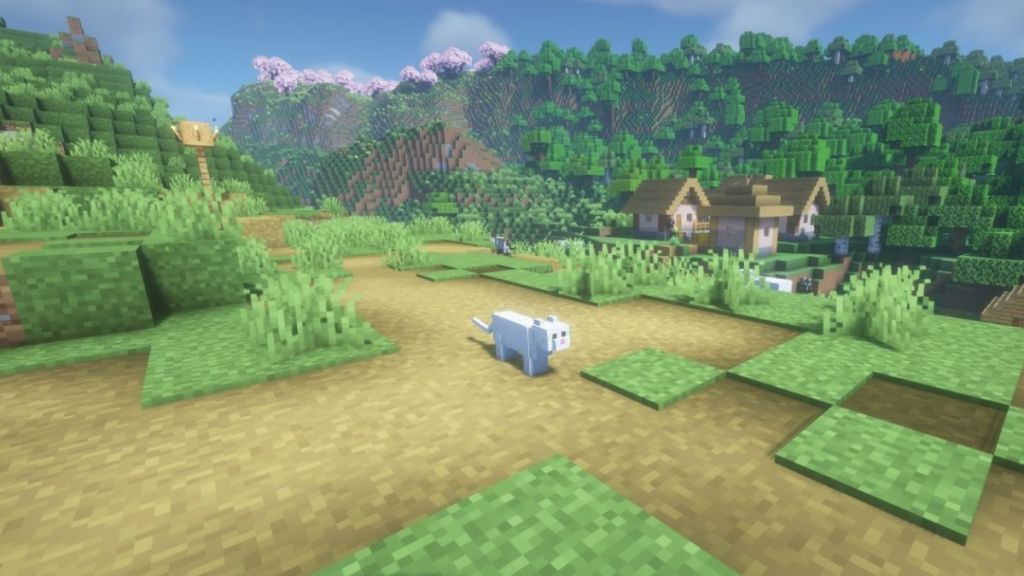
A tamed tuxedo cat follows its owner through a plains village, one of the most common early-game taming locations.
Credit: beebom.com
Training Cats for Practical In-Game Tasks
Tamed cats are far more useful than their cute appearance suggests, and training them to perform specific tasks will make your Minecraft gameplay far more efficient and safe. You can also read our guide on petarmor flea and tick for cats.
Basic Command Training
Tamed cats have two default states: follow and sit. To make your cat sit, right-click on it while it is following you; it will remain in place until you right-click it again to make it follow. You can also teleport a tamed cat to your location at any time by using the command /tp @e[type=cat,limit=1,sort=nearest] ~ ~ ~ (ensure cheats are enabled on your world). This is extremely useful if your cat gets stuck, lost, or attacked by a hostile mob. Note that teleporting a cat that is in sit mode will make it stand up and follow you again.
Creeper and Phantom Defense
One of the most valuable traits of tamed cats is their ability to deter hostile mobs. Any cat within 16 blocks of a creeper will cause the creeper to hiss and back away, preventing surprise explosions that can destroy your base or kill you. Similarly, cats within 16 blocks of a phantom will prevent the phantom from spawning entirely, eliminating the need to sleep every night to avoid phantom attacks. To maximize this protection, keep 2-3 tamed cats in your main base and around your crop farms, as creepers often spawn near unlit farm areas at night. You can also read our guide on scary noises for cat training.
Gift Collection
Tamed cats will bring you random gifts every few in-game days, as long as you have slept at least once since their last gift. Common gifts include string, feathers, rabbit hides, and raw chicken, while rare gifts include rabbit's feet, phantom membranes, and even rare music discs. To maximize gift collection, make sure your cat has access to the outdoors and is not stuck in a small enclosed space, as cats need room to roam to find gifts.
Breeding and Raising Cat Families
If you want to expand your cat population, breeding tamed cats is simple and only requires a few resources. Breeding cats will also let you get kittens with unique coat patterns, which can be a fun way to customize your base’s aesthetic. You can also read our guide on how many ounces wet food cat.
Setting Up a Breeding Enclosure
Before breeding, build a secure, enclosed 5x5 space at least 3 blocks high, with no gaps for cats to escape. Add lighting (lanterns, glowstone, etc.) to prevent hostile mobs from spawning inside the enclosure, and avoid placing chests or beds directly in the space, as cats will often sit on top of these blocks and block access. For real-life cat owners looking to replicate that low-stress, enclosed environment for their pets, low-odor enclosed litter solutions can help keep their space as tidy as your Minecraft breeding pen.
Step-by-Step Breeding Process
- Tame two adult cats of any variant.
- Feed each cat one piece of any raw fish (cod, salmon, tropical fish, etc.) until hearts appear above their heads.
- The two cats will move toward each other and a kitten will spawn within a few seconds.
- Kittens are automatically tamed at birth, inherit the collar color of one parent, and take 20 in-game minutes to grow into adult cats.
- You can feed the kitten raw fish to speed up its growth slightly.
If you only have one tamed cat, you can breed it with an untamed stray cat, but the offspring will be born untamed and will need to be tamed separately with fish. Just like real cats thrive on nutrient-dense feline meals, your Minecraft cat will stay loyal and healthy with consistent raw fish feedings. You can also read our guide on scary noises for cat training.
Advanced Cat Customization and Training
Once you’ve mastered basic taming and training, you can personalize your cats and unlock more advanced functionality with these expert tips.
Naming Cats with Name Tags
Name tags are the only way to prevent a tamed cat from despawnning, even if you leave the chunk or log out of the game. Name tags can be found in dungeon chests, stronghold chests, and abandoned mineshaft chests, or obtained via fishing. To name a cat, place the name tag and an anvil in your inventory, rename the tag at the anvil (costs 1 experience level), then right-click the cat with the renamed tag in your hand. You can name your cat anything you want, including the name of a real-life pet for a personal touch.
Customizing Collar Colors
All tamed cats spawn with a default red collar, but you can change the color of the collar using any dye in the game. To change the color, hold the dye in your main hand and right-click the cat. There are 16 possible collar colors, matching the 16 dye colors available in Minecraft. This is a great way to tell multiple cats apart, or match your cat’s collar to your base’s color scheme. The same positive reinforcement principles used to tame Minecraft cats apply to real-life cat training; for players looking to train their real pets, positive reinforcement marker tools can help speed up the process.
Preventing Cats from Sitting on Chests
A common annoyance for players is cats sitting on top of chests, blocking access to your stored items. To prevent this, place a trapdoor or carpet on top of the chest — cats cannot sit on trapdoors or carpets, so they will avoid blocking the chest. Alternatively, place the chest 1 block higher than the surrounding floor, as cats will only sit on full blocks at floor level. For a low-maintenance, hands-off pet space for your real-life cat, low-maintenance pet spaces can cut down on daily cleanup time, leaving you more time to play Minecraft.

Approaching a stray cat slowly with raw fish is critical; sudden movements will trigger its flight response.
Credit: beebom.com
Common Taming and Training Mistakes to Avoid
Even experienced players make these errors when working with cats, so avoid them to save time and frustration:
- Chasing fleeing cats: As mentioned earlier, chasing a cat that runs away will make it more skittish, forcing you to wait for it to respawn. Wait for it to stop moving, then try approaching again slowly.
- Trying to tame ocelots: Ocelots can no longer be tamed into domestic cats as of the 1.19 update, so spending time and fish trying to tame jungle ocelots is a waste of resources. Stick to stray cats in villages for taming.
- Expecting cats to fight mobs: Cats only scare creepers and phantoms; they will not attack zombies, skeletons, or other hostile mobs. Do not rely on cats for general base defense.
- Not providing a secure enclosure: Untamed cats can easily wander off or be killed by hostile mobs at night, so always keep tamed cats in a lit, enclosed area when you are not actively using them.
- Using cooked fish for taming: Cats will only accept raw fish for taming and breeding, so cooked fish is useless for these purposes.
Benefits of Having Tamed Cats
Beyond being adorable companions, tamed cats offer a range of practical benefits that improve your Minecraft experience:
- Passive creeper and phantom defense: As noted earlier, cats within 16 blocks will deter creepers and prevent phantom spawns, reducing the risk of explosions and nighttime attacks.
- Free resource gifts: Cats bring random gifts every few days, including rare items like rabbit’s feet and phantom membranes that are otherwise time-consuming to obtain.
- Ambient companionship: Tamed cats follow you around your base and will sit on your bed, chests, or nearby blocks, adding a sense of life and warmth to your builds. Their purring sound effect also adds a relaxing ambient layer to your gameplay. While your Minecraft cat’s fur stays perfectly styled without brushes, your real-life feline can get the same polished, show-ready look with professional feline grooming care.
- Villager trade bonuses: If a cat is sleeping near a villager, that villager’s trades will not be interrupted by nighttime, making it easier to trade with them at any hour.

This tutorial clip covers advanced cat customization, command usage, and gift collection tips for all player skill levels.
Credit: www.youtube.com
Frequently Asked Questions
How many fish does it take to tame a cat in Minecraft?
Most cats will be tamed after 2-5 pieces of raw fish, but skittish cats may require up to 10 pieces. Keep extra fish on hand to account for failed attempts, and stop feeding if the cat flees — wait a few seconds before trying again.
Can you make a cat sit on command?
Yes, right-click any tamed cat that is following you to make it sit. Right-click it again to make it follow you again. You can also use the /sit command on tamed cats if cheats are enabled.
Why is my cat running away from me?
If your cat runs away when you approach, you are likely moving too quickly or making sudden movements. Hold still for a few seconds to let the cat notice you, then approach slowly. If you chase the cat, it will become more skittish and may despawn.
Do Minecraft cats despawn?
Tamed cats that have been named with a name tag will never despawn, even if you leave the chunk or log out of the game. Untamed stray cats will despawn after 2 in-game days if they are not tamed, so make sure to tame them quickly after finding them.
Can you change a cat's collar color after taming?
Yes, you can change your cat’s collar color at any time by right-clicking it with any dye in your hand. There are 16 possible color options to choose from.
Conclusion
Training cats in Minecraft is a simple, rewarding process that adds significant value to your gameplay, from passive defense to rare resource gifts and comforting companionship. By understanding cat behavior, using the right taming food, and avoiding common mistakes, you can build a loyal fleet of feline friends in just a few in-game hours. If you’re looking to train your real-life cat using the same positive reinforcement principles that work for Minecraft cats, our guide to real-life cat training methods breaks down step-by-step techniques that actually work.
Grab your fishing rod, stock up on raw fish, and head to the nearest village to find your new in-game companion — you’ll wonder how you ever explored the overworld without a cat by your side. Happy gaming!