
Cats are famously bad at drinking water. They descend from desert-dwelling ancestors that got most of their fluid from prey — animals that are roughly 70–75% water — so the feline thirst drive is weak by design. Put a bowl of water next to a bowl of kibble and most cats will still end up running a mild, chronic water deficit.
Wet food fixes that quietly and effectively. A typical canned pâté is around 75–82% moisture, while dry kibble sits closer to 6–10%. That single difference means a cat eating canned food can take in several times more total water per day than a kibble-only cat — without you doing anything clever.
This guide covers how much water your cat actually needs, how to read a label for real moisture content, ten wet foods and broths worth buying, and the practical feeding routines that make hydration stick. Every product below is judged on the same thing: how much usable moisture it delivers per serving, and whether cats will actually eat it.
Why Hydration Matters More for Cats Than for Most Pets
Water is the medium for almost everything the body does — kidney filtration, digestion, temperature regulation, joint lubrication. In cats, three problems in particular trace back to low fluid intake:
- Urinary tract disease. Concentrated urine encourages crystal formation and irritates the bladder lining. Dilute urine flushes the system more often, which is why veterinarians routinely recommend increasing moisture for cats with a history of cystitis, struvite crystals or urethral blockages.
- Chronic kidney disease (CKD). Kidney disease is common in cats over 10. Damaged kidneys lose the ability to concentrate urine, so affected cats lose more water than they take in and slide into dehydration easily.
- Constipation. A dehydrated colon produces hard, dry stool. In practice, adding a can of wet food a day is one of the first things a vet suggests for a mildly constipated cat.
The U.S. Food and Drug Administration's Center for Veterinary Medicine, which regulates pet food safety and labelling, is a good starting point if you want to understand what "complete and balanced" legally means — you can browse guidance at the FDA's animal and veterinary section. For clinical background on feline urinary and kidney health, the veterinary teaching resources published by Cornell University's College of Veterinary Medicine are among the most readable non-commercial sources available.
How Much Water Does a Cat Actually Need?
A reasonable working figure is about 50 ml of water per kilogram of body weight per day, from all sources combined — roughly 3.5 to 4.5 fluid ounces daily for a 10 lb cat.
Here is what that looks like in practice:
| Diet | Moisture from food (10 lb cat, ~200 kcal/day) | Water they must drink to make up the gap |
|---|---|---|
| Dry kibble only | Roughly 0.5 oz | Nearly all of it — 3.5–4 oz |
| 50/50 wet and dry | Roughly 2–2.5 oz | 1.5–2 oz |
| All wet food (3–4 cans) | Roughly 5–7 oz | Little to none |
Most cats simply do not drink 4 ounces a day voluntarily. That is the whole argument for wet food in one line.
What to Look For in a Hydrating Wet Food
Not all "wet" food is equally hydrating. Use these filters:
1. Moisture percentage on the guaranteed analysis. Look for "Moisture (max) 78%" or higher. Pâtés and loaves usually run 75–80%; stews, shreds in gravy and broths often run 82–89%.
2. Format. Ranked by water delivered per serving: broths and lickable pouches > stews and gravies > shreds/flakes in juice > pâté > semi-moist. Pâté still beats kibble by a mile.
3. "Complete and balanced" vs. "supplemental." This is the single most misread thing on a wet food label. Broths, purées and lickable toppers are almost always labelled for intermittent or supplemental feeding only — they are hydration boosters, not meals. Complete diets carry an AAFCO nutritional adequacy statement naming a life stage. Mixing them up is how cats end up taurine-deficient.
4. Calorie density. Watery foods are low in calories per ounce — a 2.8 oz can might hold only 70–90 kcal. That is fine, but it means a 10 lb cat needs three or four cans a day, not one. If you're evaluating whether a formula truly earns its place in the bowl, it's worth understanding how a recipe stacks up nutritionally before you commit to a case.
5. Protein source and phosphorus. For healthy adults, named-meat-first recipes are the benchmark. For cats with kidney disease, moisture is only half the equation — phosphorus and protein levels matter too, and therapeutic renal formulas are a different category entirely.
6. Palatability and texture. The most hydrating food in the world is worthless if your cat walks away. Buy a variety pack before committing to a case of one flavour.
Quick Comparison: Our Ten Picks at a Glance
| Product | Format | Serving size | Complete meal? | Best for |
|---|---|---|---|---|
| Tiki Cat After Dark Pâté+ | Pâté in broth | 2.8 oz can | Yes | Highest all-round moisture in a meal |
| Nulo Freestyle Perfect Purées | Lickable purée | 0.5 oz pouch | Topper | Grain-sensitive cats, pill/meal enticement |
| Weruva Kitchen Cuties | Shreds in broth | 3.2 oz can | Complementary | Cats who prefer chunky textures |
| Tiki Cat Grill Pâté | Flaked fish pâté | 2.8 oz can | Yes | High-protein, fish-driven appetites |
| Tiki Cat Born Carnivore Broth | Pourable broth | 1.3 oz pouch | Topper | Adding water to kibble-fed cats |
| Sheba Perfect Portions | Cuts in gravy | 2.6 oz tray | Yes | Multi-cat homes, zero leftovers |
| Fancy Feast Broth Complements | Lickable broth | 1.4 oz pouch | Topper | Budget-friendly daily hydration boost |
| Tiki Cat Aloha Friends | Seafood + pumpkin | 3.0 oz can | All life stages | Digestion plus hydration |
| Weruva Mix and Match Pâté | Smooth pâté | 3.0 oz can | Yes | Kittens, seniors, dental sensitivity |
| Inaba Churu Broth | Lickable broth | 1.4 oz pouch | Topper | Sick or inappetent cats, travel |
The 10 Best Wet Cat Foods and Broths for Hydration
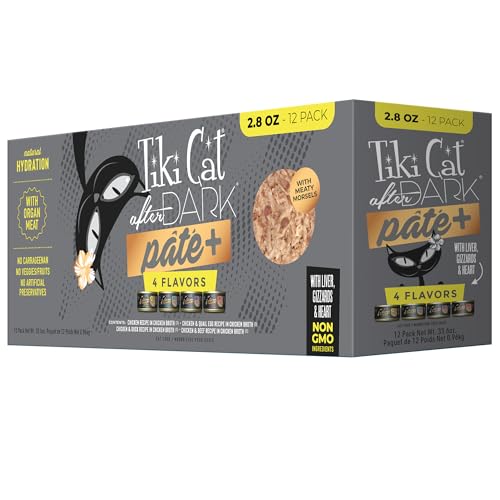
1. Tiki Cat After Dark Pâté+ Variety Pack — Best Overall Hydration in a Complete Meal

A twelve-can variety pack of pâté suspended in broth — the format that delivers the most water per meal.
This is the pick if you want one product that handles both nutrition and fluid intake. The "Pâté+" format sits the pâté in additional broth rather than packing it dry into the can, so a single 2.8 oz serving carries noticeably more free liquid than a standard loaf. Cats that normally leave gravy behind tend to finish this because the broth is bound to the pâté rather than pooling separately.
What we like
- Broth-suspended pâté pushes moisture well above a standard loaf
- Variety pack prevents the flavour fatigue that kills long-term compliance
- Organ-inclusive recipes from a brand with a strong reputation for carnivore-appropriate formulation
- The 2.8 oz can is a genuinely useful portion unit — easy to feed as half-cans twice a day
- Compact cans stack neatly and there's minimal leftover waste
Trade-offs
- Premium price; feeding a 10 lb cat exclusively on this gets expensive fast
- Rich organ meats don't suit every stomach — introduce gradually
- Always check the ingredient panel if your cat has a diagnosed protein allergy
In practice: because each can is modest in calories, a 10 lb adult will need roughly three to four cans daily on an all-wet plan. Many owners use this as the morning and evening meal and fill the middle of the day with a lower-cost option.
👉 Stock a case and let your cat pick a favourite flavour — check the current variety-pack price.
2. Nulo Freestyle Grain-Free Perfect Purées — Best Squeezable Topper

Half-ounce lickable pouches — small, but unusually effective at getting reluctant cats to start eating.
Lickable purées earn their place for one reason: they trigger eating behaviour. Squeeze one over a bowl of food a cat has been ignoring and the licking reflex often restarts the meal. That makes them useful far beyond their own moisture content.
What we like
- Grain-free recipe suits cats with grain sensitivities
- Genuinely high moisture in a format cats rarely refuse
- The pouch is mess-free — no forks, no crusted bowls, easy to take to the vet
- 0.5 oz portions make it hard to accidentally overfeed treats
- Excellent for disguising powdered supplements or crushed medication (check with your vet first)
Trade-offs
- Supplemental only — this is not a meal replacement
- Expensive per ounce compared with canned food
- A minority of cats need a few exposures before they accept the smooth texture
In practice: stir one pouch into a tablespoon of warm water and pour it over dry food. You've just added an ounce of water to a kibble meal without changing the diet at all. It's the same trick that makes training rewards work — high-value flavour used deliberately.
👉 Grab a pack and turn any meal into a hydration opportunity.
3. Weruva Cats in the Kitchen "Kitchen Cuties" Variety Pack — Best for Texture-Fussy Cats

Shredded, human-grade-style cuts sitting in visible broth — a favourite with cats that reject pâté outright.
Weruva's shred-in-broth style is what converts pâté refusers. You can see the muscle fibres in the can, and there's usually a generous pool of liquid at the bottom that most cats lap up first.
What we like
- Recognisable whole-muscle shreds rather than emulsified paste
- Broth-heavy cans deliver more free water than a dense loaf
- Twelve flavours in one box — ideal for identifying preferences cheaply
- 3.2 oz cans are a sensible single-serve size for medium cats
- Long-standing brand with a transparent sourcing reputation
Trade-offs
- Some Weruva recipes are complementary rather than complete — read the adequacy statement on each variety
- Shreds are lower in calories per can than dense pâtés, so cats need more of them
- Higher shelf price than supermarket brands
In practice: if your cat licks the broth and abandons the shreds, mash it with a fork before serving. Blending it into a slurry usually gets the whole can eaten. If you're comparing this against other premium canned lines, our roundup of top-rated canned formulas covers the wider field.
👉 See whether shreds or pâté win in your house.
4. Tiki Cat Grill Pâté Variety Pack — Best High-Protein Option

Flaked fish worked into a smooth pâté — protein-dense and easy to eat for cats with sore mouths.
This line pairs real flaked fish with a smooth, spoonable pâté texture. It's the option to reach for when you want moisture and meaningful protein density in the same can — useful for active adults and for cats losing muscle mass with age.
What we like
- Named fish proteins high on the ingredient list
- Protein-forward formulation supports lean muscle maintenance
- Smooth texture suits cats with dental disease or missing teeth
- 2.8 oz cans give precise portion control
- Consistently strong palatability among fish-motivated cats
Trade-offs
- Heavily fish-based, so it's not the right long-term staple for every cat — rotate proteins
- Cats that prefer chunks may snub the uniform texture
- A case of twelve takes up more cupboard space than it looks like it will
In practice: fish recipes are the best "starter" flavour for a cat you're transitioning off kibble, because the aroma is stronger. Once they're eating wet food reliably, rotate to poultry and rabbit recipes to keep the diet varied.
👉 Try the fish-forward pâté cats rarely walk away from.
5. Tiki Cat Born Carnivore Broths, Salmon — Best Pourable Broth

A thin, pourable salmon broth designed to be tipped straight over an existing meal.
Broths are the highest-moisture product category you can buy, and they're the easiest intervention for owners who aren't ready to switch diets. You keep the food your cat already eats and pour water-with-flavour on top.
What we like
- Real salmon base with the kind of aroma that pulls cats to the bowl
- Extremely high moisture per serving — essentially flavoured water with nutrients
- 1.3 oz pouches serve cleanly with no dilution needed
- Free from artificial colours
- Works equally well over kibble or canned food
Trade-offs
- One pouch won't be enough for a large cat if you're relying on it alone
- Supplemental only — not nutritionally complete
- Refrigerate and use within 24 hours once opened
In practice: a common mistake is pouring broth over a full bowl of kibble and leaving it out. The kibble goes soggy, the cat abandons it and the bowl becomes a bacterial problem. Pour it over a small portion the cat will finish in one sitting.
👉 Add real moisture to the food your cat already eats.
6. Sheba Perfect Portions Cuts in Gravy — Best for Multi-Cat Households

Snap-apart twin trays: one half now, one half later, with no half-empty can in the fridge.
The twin-pack tray design solves the most annoying problem in wet feeding — the leftover. Snap the tray, serve one half, refrigerate the other. Nothing dries out, nothing gets binned.
What we like
- 48 servings per box makes daily wet feeding logistically painless
- Cuts sit in a genuine gravy, which adds free liquid on top of the meat's own moisture
- Three rotating proteins: roasted chicken, salmon and turkey
- Widely stocked, so you're never stuck mid-transition without your cat's food
- No refrigeration needed until a tray is opened
Trade-offs
- 2.6 oz per serving is small for a large or very active cat
- Variety-pack-only means you may end up with a flavour your cat ignores
- Gravy-heavy foods leave more residue in the bowl — wash daily
In practice: in multi-cat homes, portioned trays make it far easier to see who ate what. Pair that with monitoring habits — clump size in the boxes they use every day is one of the most reliable early indicators that a cat's fluid intake has changed.
👉 Simplify twice-daily wet feeding for every cat in the house.
7. Purina Fancy Feast Broth Complements — Best Budget Hydration Booster

Classic broth pouches — the cheapest reliable way to add a daily ounce of water to a cat's diet.
If cost is the barrier to feeding wet, this is where to start. Broth complements deliver a meaningful moisture bump at a fraction of the price of premium canned food, and the flavour profile is one that decades of cats have already voted for.
What we like
- Very affordable per pouch — realistic for daily, long-term use
- Small pieces of meat suspended in broth, so it reads as food rather than soup
- 1.4 oz pouches are portion-controlled and travel well
- Backed by one of the largest quality-control operations in pet food
- Excellent starting point for cats that have never eaten anything but kibble
Trade-offs
- Explicitly a complement, not a meal — the label says so
- Some cats lick the broth and leave the solids
- Multi-cat homes will get through a 12-pack quickly
In practice: this is the product we'd hand to someone whose cat has just had a urinary scare and who needs to increase moisture today, before a full diet transition is realistic.
👉 Boost daily water intake without changing your cat's food.
8. Tiki Cat Aloha Friends with Pumpkin — Best for Digestion Plus Hydration

Seafood recipes with added pumpkin — moisture and gentle fibre in the same 3 oz can.
Pumpkin adds soluble fibre, which helps normalise stool at both ends of the spectrum. Combine that with a high-moisture seafood base and you have a useful food for cats prone to constipation or occasional loose stool.
What we like
- Formulated for all life stages, so one case works for a mixed-age household
- Added pumpkin supports regular, well-formed stools
- High-moisture seafood recipes with strong protein content
- 3 oz cans — slightly larger than most premium tins, so fewer cans per day
- Reliable palatability among seafood-loving cats
Trade-offs
- Twelve cans is a lot of the same protein family for a single-cat home
- Selective cats may reject one or two of the seafood combinations
- Seafood diets shouldn't be the only protein a cat eats indefinitely
In practice: if your cat's stools are dry and pellet-like, moisture is usually the lever to pull before fibre. Adding a food like this changes both variables at once, which is exactly what you want for mild, ongoing constipation.
👉 Support hydration and digestion in one bowl.
9. Weruva Mix and Match Game Pâté Variety Pack — Best for Kittens and Seniors

Eighteen smooth pâté cans — the easiest texture for tiny mouths and worn-down teeth.
Smooth pâté is the most forgiving texture in wet food. Kittens with baby teeth, seniors with resorptive lesions and cats recovering from dental extractions can all eat it without effort — and it warms and softens easily.
What we like
- Eighteen cans per box brings the per-can cost down meaningfully
- Smooth, uniform texture suits every age and dental condition
- Grain-free recipes with named proteins
- High moisture with a soft consistency that thins nicely with warm water
- Genuine flavour variety in a single purchase
Trade-offs
- Pâté holds less free liquid than shreds or stews unless you thin it
- Chunk-loving cats may refuse the texture entirely
- Premium pricing and sometimes easier to find online than in store
In practice: stir one tablespoon of warm water into each serving of pâté. It raises moisture, releases aroma and — for older cats with a dulled sense of smell — often makes the difference between a picked-at bowl and a clean one. If you want alternatives in this texture class, we've compiled more canned meal picks worth comparing.
👉 Buy the eighteen-can pack and cut your cost per meal.
10. Inaba Churu Broth for Cats — Best for Sick or Inappetent Cats
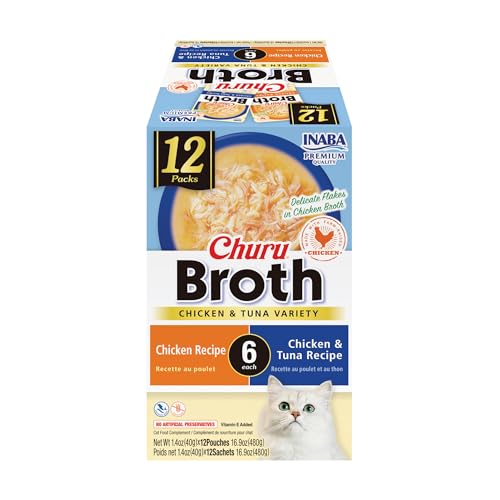
Chicken and tuna broth in single-serve pouches — the emergency option when a cat stops eating.
Inaba's broth format has a specific superpower: it gets food into cats that have decided they aren't eating. Post-anaesthesia, during an upper respiratory infection, in the days after a house move — this is the product that restarts intake.
What we like
- Chicken and tuna varieties with near-universal appeal
- Very low in calories, so it won't unbalance a controlled diet
- Serve straight from the pouch, from a saucer, or by hand
- High moisture in a format cats will lap voluntarily
- Compact enough for a carrier bag or vet-visit kit
Trade-offs
- Supplemental only — never a substitute for complete food
- One pouch is a light serving for a big cat
- Refrigerate any unused portion and discard after 24 hours
In practice: keep two or three pouches in the cupboard permanently. A cat that refuses food for more than 24–48 hours risks hepatic lipidosis, and a broth that tempts them into licking buys time while you get a vet appointment. It is a stopgap, not a treatment — call the vet regardless.
👉 Keep a pack on hand for the days your cat won't eat.
Wet vs. Dry: An Honest Comparison
Wet food is not automatically superior in every respect. Here's the balanced version:
| Factor | Wet food | Dry food |
|---|---|---|
| Moisture | 75–85% | 6–10% |
| Cost per calorie | Higher, often 2–4× | Lower |
| Dental effect | Neutral; no meaningful cleaning action | Marginal at best, unless a prescribed dental diet |
| Free-feeding | Unsafe beyond 1–2 hours at room temperature | Can be left out |
| Satiety per calorie | Higher — helpful for weight control | Lower; easy to overeat |
| Storage | Fridge after opening, 3–5 days covered | Sealed container, months |
| Convenience for travel/automation | Requires a chilled feeder | Simple |
The honest verdict: wet food wins decisively on hydration and satiety, and loses on cost and convenience. For most households, a mixed approach — wet meals morning and evening, a measured portion of dry in a puzzle feeder for daytime enrichment — captures most of the benefit at a manageable price.
If routine is the obstacle, the fix is usually mechanical rather than dietary. A chilled timed dispenser keeps canned food safe for hours and lets you feed wet meals even when you're out all day.
How Much Wet Food Should You Feed?
Work from calories, not cans. The rough starting point for a lean, neutered, indoor adult cat is about 20 kcal per pound of ideal body weight per day — so around 200 kcal for a 10 lb cat. Kittens need considerably more; very sedentary or overweight cats need less.
Then check the calorie content printed on the can (it's the "kcal/can" or "kcal/kg" figure required on every label):
- Can at 70 kcal → roughly 3 cans/day for a 10 lb cat
- Can at 90 kcal → roughly 2¼ cans/day
- Can at 120 kcal → roughly 1¾ cans/day
Split it into at least two meals, ideally three or four. Cats are natural nibblers and small frequent meals suit their metabolism better than one large serving.
Weigh your cat monthly. If the number is drifting up, cut portions by 10% and reassess in four weeks — not by eye, by scale.
How to Transition a Kibble Addict to Wet Food
Some cats switch in a day. Kibble-imprinted cats can take weeks. Never starve a cat into compliance — going without food for 48 hours can trigger serious liver disease.
A workable seven-to-fourteen-day plan:
- Days 1–2: Move from free-feeding to two or three scheduled meals of the current food. Cats that are never hungry will never try anything new.
- Days 3–4: Put a teaspoon of wet food on a separate saucer next to the kibble. No pressure, no mixing. Remove after 20 minutes.
- Days 5–7: Mix a teaspoon of wet into the kibble portion, or crumble a few kibbles over the wet food as a "bridge" texture.
- Days 8–11: Shift the ratio to roughly 50/50 by calories.
- Days 12–14: Move to 75% wet, then all wet if you're going that route.
Tricks that reliably help:
- Warm it. Ten seconds in the microwave, stirred thoroughly and tested on your wrist, to just below body temperature. Aroma drives feline appetite far more than taste.
- Use a wide, shallow ceramic dish. Deep bowls press on whiskers and put sensitive cats off.
- Serve fresh. Straight from the fridge is a common refusal trigger.
- Change one variable at a time. New food and new bowl and new location is three changes too many.
Behavioural groundwork pays off here too — cats that respond to structured reward-based sessions tend to accept diet changes with less resistance, because novelty has already been paired with something good.
Beyond the Bowl: Other Ways to Raise Fluid Intake
Wet food does the heavy lifting, but stack these on top:
- Multiple water stations. One per cat plus one, in different rooms, away from food and litter. Cats instinctively avoid drinking near where they eat or eliminate.
- A circulating fountain. Moving water attracts many cats. Clean it weekly and change filters on schedule — a slimy fountain is worse than a fresh bowl.
- Wide, shallow bowls in glass, ceramic or stainless steel. Plastic scratches, harbours bacteria and can taint the taste.
- Add water to meals. One to two tablespoons stirred into each serving of wet food is barely noticeable to the cat and adds up to a meaningful amount over a week.
- Ice cubes in summer, or a cube made from tuna water (in spring water, no salt) as an occasional novelty.
- Refresh water twice daily. Standing water goes flat and dusty, and fussy cats notice.
Signs of Dehydration Every Owner Should Recognise
Catching dehydration early matters. Watch for:
- Skin tent test: gently lift the skin between the shoulder blades. It should snap back instantly. Skin that stays tented for a second or more suggests dehydration. (Note: this is less reliable in very thin or very old cats.)
- Tacky or dry gums instead of slick and moist
- Sunken, dull-looking eyes
- Lethargy, hiding, reduced grooming, a rough or flaky coat
- Fewer or smaller urine clumps in the litter box — one of the earliest signals, and the reason litter maintenance doubles as health monitoring
- Hard, dry, pellet-like stools
- Loss of appetite
Get to a vet promptly if you see any of these alongside vomiting, diarrhoea, straining in the litter box, or crying while urinating. A male cat straining without producing urine is a life-threatening emergency — go immediately.
Because urine volume is such a useful indicator, litter setup genuinely matters. Systems that log or sift automatically — like sensor-equipped sifting units — make it much easier to notice the day output changes, and a good odour-controlling setup keeps you willing to check the box daily rather than avoiding it.
Special Situations
Chronic Kidney Disease
Moisture is essential, but so is controlled phosphorus and moderated, high-quality protein. Cats with CKD often become finicky as the disease progresses, so warming food and rotating textures becomes a daily task. Therapeutic renal diets should be chosen with your vet, not from a shelf.
Urinary Crystals and Cystitis
Dilution is the goal. All-wet feeding, multiple water sources and stress reduction are the standard three-part approach. Ask your vet whether your cat's crystal type (struvite vs. calcium oxalate) affects the diet choice — they are managed differently.
Diabetic Cats
Canned foods are generally lower in carbohydrate than kibble, which suits diabetic management, but never change a diabetic cat's diet without adjusting insulin under veterinary supervision — blood glucose can drop fast.
Kittens
Kittens need calorie-dense, complete-and-balanced food labelled for growth or all life stages. Free-feeding wet food isn't safe; instead, offer four to five small meals a day and remove leftovers within 30 minutes.
Senior Cats
Declining smell, dental pain and reduced thirst all stack against older cats. Warm the food, use smooth pâtés, serve smaller portions more often, and weigh monthly — unexplained weight loss in a senior cat always warrants a vet visit.
Storage and Food Safety
- Unopened cans and pouches: cool, dry cupboard. Check best-before dates when you buy a case.
- Opened cans: transfer to a glass or plastic container or use a fitted can lid, refrigerate, and use within three days (many brands say five; three is safer for aroma and palatability).
- Room temperature limit: don't leave wet food down for more than 1–2 hours, and less in hot weather. Bacteria multiply quickly in a warm, moist, protein-rich medium.
- Opened broths and toppers: refrigerate and use within 24 hours.
- Wash bowls daily with hot soapy water. Biofilm on a bowl rim causes more refusals than owners realise, and has been implicated in feline chin acne.
- Never microwave in the can. Decant first, stir, and check the temperature — hot spots burn mouths.
Five Common Mistakes to Avoid
- Treating a broth or purée as a meal. Supplemental products lack complete nutrition. Check for the AAFCO adequacy statement.
- Switching cold turkey. Abrupt changes cause GI upset and food aversion — which can set your cat against that food permanently.
- Serving straight from the fridge. Cold food has almost no aroma. To a cat, no aroma means no food.
- Leaving wet food out all day. It spoils, attracts flies, and teaches the cat that wet food smells bad.
- Not adjusting portions after the switch. Wet food is less calorie-dense per ounce than kibble. Feeding the same volume usually means underfeeding; feeding the same number of cans as a bigger cat means overfeeding. Work from kcal.
Frequently Asked Questions
How much moisture does wet cat food actually contain?
Most canned cat foods contain 75–85% moisture; broths and lickable toppers can reach 85–90%. Dry kibble is typically 6–10%. Check the "Moisture (max)" figure in the guaranteed analysis panel on the label — it's required on every product sold in the US.
Can wet food alone keep my cat fully hydrated?
For a healthy adult cat, largely yes. A 10 lb cat eating three to four cans a day takes in roughly 5–7 oz of water from food, which covers typical daily needs. Always provide fresh drinking water anyway — needs rise in hot weather, during illness, and with kidney disease.
Are broths and lickable toppers complete meals?
No. Almost all are labelled "for intermittent or supplemental feeding only." Use them to boost moisture and appetite alongside a complete diet, not as a replacement. Keeping toppers under about 10% of daily calories is a sensible rule.
Is grain-free wet food more hydrating?
Not inherently. Moisture content is determined by the recipe's water and broth, not by whether grain is present. Grain-free formulas may suit cats with specific sensitivities, but "grain-free" and "high-moisture" are unrelated claims — read the guaranteed analysis rather than the marketing.
How often should I feed wet food?
Two to four meals a day works for most adult cats; kittens need four or five. Splitting the daily ration into smaller, more frequent meals suits feline digestion and spreads fluid intake through the day rather than concentrating it.
Will wet food ruin my cat's teeth?
This is the most persistent myth in cat feeding. Standard dry kibble shatters on contact and provides negligible abrasive cleaning — only specifically formulated dental diets with larger, fibre-aligned kibble have a demonstrable effect. Dental health depends on brushing, veterinary cleanings and genetics far more than on food texture.
Can I mix wet and dry food in the same bowl?
Yes, though serve it fresh and remove leftovers within an hour or two, since moistened kibble spoils faster than either food alone. Many owners prefer feeding wet meals at set times and offering measured dry food separately in a puzzle feeder.
My cat refuses wet food entirely. What now?
Go slowly. Stop free-feeding first, warm the wet food, use a wide shallow dish, and start with a smear rather than a portion. Bridge textures — crumbled kibble on top, or a lickable topper stirred through — help enormously. If your cat has never eaten anything but dry food, expect two to four weeks, not two days.
Does wet food cause diarrhoea?
Only usually during too-fast transitions, or with a specific ingredient intolerance. Introduce over 7–14 days. Persistent diarrhoea beyond 48 hours needs veterinary attention rather than another food change.
Is more expensive wet food actually better?
Sometimes. Price often buys better protein sourcing and fewer fillers, but a mid-priced complete-and-balanced canned food that your cat eats consistently beats a premium food they refuse. Consistency of intake matters more than the label.
The Bottom Line
Hydration is the single most under-appreciated lever in feline health, and it's also one of the easiest to pull. You don't need supplements, gadgets or a veterinary prescription — you need moisture in the bowl.
Your practical action plan:
- Start with a variety pack, not a case of one flavour. Tiki Cat After Dark Pâté+ is our all-round pick for a complete, genuinely high-moisture meal.
- If your cat won't eat canned food yet, begin with a broth — Fancy Feast Broth Complements for budget, Tiki Cat Born Carnivore for quality, Inaba Churu for reluctant eaters.
- Transition over 7–14 days, warming every serving and offering it in a wide shallow dish.
- Feed by calories, not cans — roughly 20 kcal per pound of ideal weight, split into two to four meals.
- Watch the litter box. Bigger, more frequent urine clumps are the clearest proof your changes are working.
- Loop in your vet if your cat has kidney disease, diabetes, urinary history, or is over ten years old.
Give it a fortnight and most owners notice the same things: glossier coat, softer stools, more energy, and a visibly wetter litter box. That last one is not glamorous, but it is the metric that matters.
Pick one product from the list above, order a variety pack today, and start with a single warmed teaspoon at tonight's meal — that's how nearly every successful switch begins.