
A cat that growls, swats, or bites is not a "bad" cat. Aggression is communication — usually the last thing a cat tries after quieter signals (a flicked tail, a turned ear, a stiffened spine) have been missed or ignored. Once you learn to read those earlier signals and remove the trigger behind them, most household aggression becomes manageable, and a good share of it disappears entirely.
This guide walks through how to identify the type of aggression you're dealing with, how to de-escalate safely in the moment, what to change in the home, when a veterinary workup is non-negotiable, and what a realistic recovery timeline looks like. It also covers the mistakes that quietly make aggression worse — including several pieces of advice still floating around online that behavior professionals abandoned years ago.
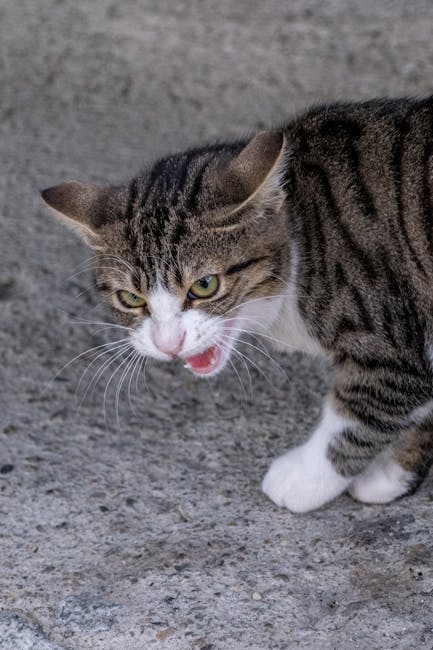
A classic defensive posture: flattened ears, wide pupils, weight shifted back. This cat wants distance, not a fight.
Credit: justcatsclinic.com
First: Rule Out Pain Before You Rule Out Anything Else
The single most common mistake owners make is treating a behavior problem as a training problem when it started as a medical one.
Any cat with a sudden change in temperament — a friendly 9-year-old who now bites when picked up, a lap cat who screams at a brush stroke — needs a veterinary exam before behavior work begins. Cats hide illness exceptionally well, and irritability is often the first visible symptom.
Conditions that frequently present as aggression:
| Condition | Typical clues |
|---|---|
| Dental disease / tooth resorption | Head-shy, drops food, drools, bites when face is touched |
| Osteoarthritis (very common over age 10) | Dislikes being lifted, stops jumping, snaps when hindquarters touched |
| Hyperthyroidism | Weight loss with a big appetite, restlessness, vocalising, short fuse |
| Urinary tract disease / cystitis | Litter box avoidance, straining, sensitivity around the belly |
| Otitis (ear infection) | Head tilt, scratching, reacts violently to head handling |
| Neurological issues, hypertension, cognitive decline | Disorientation, night yowling, unpredictable outbursts |
| Flea or mite irritation | Twitchy skin, over-grooming, sudden swats during petting |
That last one is worth a mention: relentless itching frays any animal's patience, so keep year-round parasite protection options consistent rather than seasonal. Ask your vet for a pain trial if arthritis is suspected — a two-to-four-week course of an appropriate analgesic often resolves "grumpiness" that no amount of training would have touched. The veterinary profession's national association and university feline-health programs both list pain as a leading driver of feline behavior change, and it is the cheapest problem to fix once identified.
Never give human painkillers to a cat. Acetaminophen and ibuprofen are lethal to felines even in small doses.
Reading the Warning Signs Before Teeth Come Out
Cats escalate in a predictable ladder. Your job is to intervene at rung one or two.
The escalation ladder
- Freeze / stare — body stills, eyes lock on.
- Tail signals — thrashing, thumping, or a fast twitch at the tip.
- Ears — rotating sideways ("airplane ears"), then flattening back.
- Skin ripple — twitching along the back, especially during petting.
- Vocal — low growl, then hiss, then a sharp yowl.
- Contact — swat with claws sheathed, then unsheathed, then bite.
If you consistently stop interacting at step 1 or 2, most cats never reach step 6. In practice, owners miss the tail and ear signals because they're watching the face.
Offensive vs. defensive posture
- Offensive (confident, moving forward): stiff legs, elevated rear, direct stare, constricted pupils, tail down and rigid, ears forward and slightly rotated.
- Defensive (frightened, wanting escape): crouched, tucked head, dilated pupils, flattened ears, tail wrapped or tucked, piloerection (puffed fur), rolling onto the back with all four sets of claws ready.
A defensive cat is asking for space. Cornering it is what converts fear into a bite. Give a wide berth and it will usually de-escalate on its own within a few minutes.
Play vs. real aggression
| Play | Aggression |
|---|---|
| Claws usually sheathed, bites inhibited | Claws out, bite holds and shakes |
| Silent or chirping | Growls, hisses, yowls |
| Loose, bouncy movement; pauses and re-engages | Rigid, sustained, no breaks |
| Body sideways with a "hop" | Body low and locked, or fully upright and stiff |
| Recovers instantly when you stop | Stays aroused for many minutes after |
If you want a broader foundation in what your cat's everyday postures mean, decoding everyday feline habits makes the warning signs above far easier to spot in real time.
The Types of Cat Aggression — and the Fix for Each
Treatment depends entirely on the category. Applying the wrong strategy is why so many owners feel stuck.
1. Fear-based aggression
Looks like: defensive crouch, hiss, explosive swat when approached or trapped. Triggered by vet visits, carriers, strangers, vacuum cleaners, moving house.
Fix: Increase escape routes and hiding options. Never chase, corner, or "reassure" by leaning over a frightened cat. Use desensitisation — expose the cat to a weak version of the trigger (the vacuum in another room, unplugged) paired with food, and increase intensity only when the cat eats calmly. Progress in sessions of 3–5 minutes, once or twice daily.
2. Petting-induced aggression
Looks like: the cat solicits attention, enjoys 30–90 seconds of stroking, then whips around and bites your hand.
Fix: Count your strokes. Most cats with this pattern have a threshold; stop at roughly half of it and let the cat re-invite you. Stick to the cheeks, chin, and base of the ears — the areas cats scent-mark with — and avoid the belly and tail base. Watch for the skin ripple and tail twitch, then lift your hand before the bite. Owners who master this usually see the biting stop within a couple of weeks.
3. Play aggression (very common in young, single cats)
Looks like: ambushing ankles from under furniture, biting hands during play, hyperactive evening "zoomies" that turn into attacks.
Fix: Hands are never toys — not once, not as kittens. Redirect onto wand toys and use a predatory sequence that ends properly: stalk → chase → pounce → "kill" → a meal. Two 10–15 minute play sessions a day, ideally before feeding, drain far more energy than an hour of half-hearted string flicking. Rotate toys weekly so novelty stays high, and add puzzle feeders so hunting happens all day.
4. Redirected aggression
Looks like: the cat sees a stray outside, becomes hugely aroused, and attacks the nearest cat or human. This is the most dangerous and most misunderstood type because the victim did nothing.
Fix: Block the trigger — window film on the lower half of the glass, motion-activated deterrents outside, remove bird feeders from view. Separate immediately and do not touch the cat. Arousal can take hours, occasionally a day or more, to fade. Put the cat in a quiet, dim room with food, water, and a box, close the door, and leave it alone. Reintroduce cats to each other slowly afterward, as if they were strangers.
5. Territorial and inter-cat aggression
Looks like: blocking access to doorways, staring, ambushing at the litter box, chasing, spraying.
Fix: Resource competition is nearly always the driver. The working rule is one of everything per cat, plus one, spread across different rooms and levels — food stations, water bowls, beds, scratching posts, and litter boxes. Households with three or more cats do best with boxes sized for busy households placed so no cat can be trapped in a corner while using one. Add vertical territory: shelves, tall trees, and window perches let cats share a room without sharing floor space.
6. Maternal aggression
Looks like: a normally sociable queen guarding kittens fiercely for the first few weeks.
Fix: Give space, limit visitors, and handle kittens briefly and calmly. It resolves naturally as the kittens wean. Spaying prevents recurrence.
7. Idiopathic aggression
Rare, severe, and unpredictable, with no identifiable trigger. This is a diagnosis of exclusion — it requires a full medical workup and a board-certified veterinary behaviorist, not internet advice.

Inter-cat tension often shows as silent staring and blocked pathways long before any fighting starts.
Credit: justcatsclinic.com
What to Do in the Moment: A Safe De-escalation Protocol
When a cat is already lit up, behavior modification is off the table. Your only goals are safety and cooling down.
- Stop moving. Sudden motion looks like prey or threat. Stand still, turn slightly sideways, and avoid direct eye contact.
- Do not reach for the cat. Not to comfort, not to move it, not to "show who's boss."
- Create a barrier. Slide a piece of cardboard, a cushion, a laundry basket, or a baking tray between you and the cat.
- Break line of sight. Toss a thick towel or blanket over the cat only if you must move it — and only with heavy gloves.
- Leave the room, or let the cat leave. Open a door to a quiet space and step away.
- Give it time. Allow at least 30 minutes for a mild incident and several hours for a severe one before any interaction.
- Do not punish afterward. Cats do not connect punishment with a past event; they connect it with you.
Never do these: scruffing an adult cat, holding it down, spraying water, yelling, flicking the nose, or "alpha rolling." All of them raise arousal, damage trust, and are strongly linked to worse aggression over time. The dominance framework applied to cats is outdated — cats are not pack animals and do not respond to hierarchy displays.
If you're bitten or scratched
Cat bites are puncture wounds that seal over bacteria. Wash immediately with soap and running water for several minutes, then contact a doctor the same day — bites over a joint, on the hand, or that swell and redden need prompt medical attention and often antibiotics. Keep rabies vaccination current, and tell your physician the animal's vaccination status.
Building the Environment That Prevents Aggression
Most chronic aggression is an environment problem wearing a behavior costume.
Resources, spaced properly
- Litter: clean at least once daily. A dirty or hard-to-reach box creates ambush points and stress-linked outbursts; matching a low-dust, unscented substrate to a box the cat can turn around in solves more conflict than owners expect. If odour control has you cleaning less often than you should, odour-fighting box designs remove the excuse.
- Food: feed cats in separate rooms or at opposite ends of a long room. Guarded bowls generate daily low-grade tension.
- Water: at least one station away from food; many cats prefer moving water.
- Vertical space: a cat that can go up rarely needs to fight across.
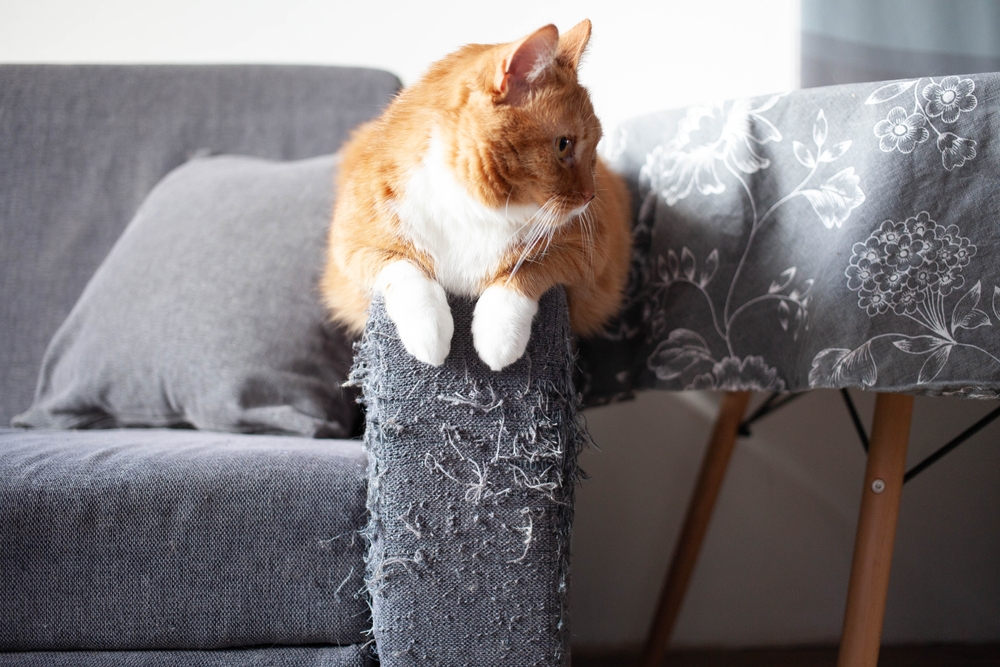
- Scratching: one sturdy vertical post per cat, tall enough for a full stretch, plus a horizontal option.
Hiding and safe zones
Every cat needs at least one spot where no human or animal follows — a covered bed, an open cupboard, a box on a shelf. In multi-pet homes, a "safe room" with its own litter box, food, water, and door you can close is essential during any behavior program.
Diet and routine
Hunger-driven irritability is real, especially with once-a-day feeding. Split meals into three to five smaller portions or use a timed feeder. Hydration matters too — moisture-rich meals support urinary health, and urinary pain is a documented aggression trigger. Many households do well mixing textures at mealtimes so puzzle feeders can hold kibble while wet food covers hydration. If your cat is older or has a diagnosis, small daily diet upgrades are usually more sustainable than a sudden switch.
Pheromones and calming aids
Synthetic feline facial pheromone diffusers can take the edge off territorial tension in some homes. They are an adjunct, not a treatment — expect a modest effect over 2–4 weeks, plugged in the rooms the cat actually uses, and keep working on the underlying trigger.
Training That Actually Works With Cats
Cats learn well — they just don't work for praise the way dogs do. Everything below rests on positive reinforcement; aversives are counterproductive with an already-aggressive animal.
Use a marker
Mark the exact instant the cat does something you want, then pay. A click or a consistent word ("yes") works; the timing matters more than the sound. If you're starting from scratch, a good marker device makes your timing sharper than a spoken cue ever will.
Pay well
Reinforcement must beat the value of the behavior you're replacing. Freeze-dried meat, a lick of wet food from a spoon, or purpose-made high-value reward morsels work; a dry biscuit the cat can eat any time does not. Keep pieces tiny — pea-sized — so you can deliver 15–20 reps without overfeeding.
Core exercises
- Station training: reward the cat for going to a mat or perch. This gives you a non-confrontational way to move a tense cat out of a doorway.
- Consent handling: offer a hand; reward only if the cat approaches and rubs. Never continue if it leans away.
- Counter-conditioning the trigger: trigger appears at a distance the cat notices but doesn't react to → food appears. Trigger vanishes → food stops. Repeat, shrinking distance by inches over weeks.
- Carrier and handling desensitisation: leave the carrier out permanently with bedding and treats inside. This alone prevents an enormous amount of vet-visit aggression.
Sessions should be short — 3–5 minutes, two or three times a day — and always end while the cat still wants more. A structured approach to gentle teaching methods will keep you consistent across the weeks it takes.
Try this today: run one 5-minute wand-toy session before dinner, ending with a "caught" toy and a meal. Owners of play-aggressive cats often notice fewer ankle ambushes within the first week.
Introducing or Reintroducing Cats Without a Fight
Whether you're adding a cat or repairing a relationship after a redirected-aggression incident, the process is identical — and rushing it is the number one cause of permanent inter-cat hostility.
Stage 1 — Full separation (3–7 days minimum). Each cat has its own room with all resources. Swap bedding and rub a soft cloth on each cat's cheeks, then leave it in the other's space.
Stage 2 — Scent and sound only. Feed both cats on opposite sides of a closed door, moving bowls closer over several days. Any hissing means move the bowls back.
Stage 3 — Visual contact, barrier in place. Use a baby gate with a towel over the top half, or crack the door a couple of inches. Short sessions, both cats eating or playing. End before anything sours.
Stage 4 — Supervised together, one room, both engaged. Two people, two wand toys, 5 minutes. Build up gradually.
Stage 5 — Free access, with hiding spots, vertical routes, and duplicated resources permanently in place.
If a stage produces growling or a stare-down, drop back one stage for several days. Total timeline for a difficult pair is commonly 4–12 weeks. Keep litter fully separated during the process; a shared box under tension can wreck weeks of progress, which is why some households add a second setup — even a simple additional box station — before the introduction begins rather than after.

Trust is rebuilt in small, low-pressure exchanges — food offered at a distance the cat chooses to close.
Credit: animals.howstuffworks.com
Tracking Progress: The Aggression Log
Memory is unreliable and progress with cats is gradual. Keep a simple log — a notes app is fine — with five columns:
| Date/time | Trigger | Intensity (1–5) | Duration | What ended it |
|---|---|---|---|---|
| e.g. Tue 7pm | Neighbour cat at window | 4 | 20 min | Separated to back room |
After three to four weeks you'll see patterns invisible day to day: incidents clustering at dusk, or only when a particular person is home, or always within an hour of an empty food bowl. Bring this log to your vet — it turns a vague "he's aggressive" into a diagnosable pattern and is the single most useful thing you can hand a behavior professional.
When to Bring in a Professional
See your veterinarian promptly if:
- Aggression appeared suddenly in an adult or senior cat
- The cat is over 8 and newly irritable when handled
- There's any bite that broke skin, on a person or another pet
- Aggression comes with weight change, appetite change, vocalising at night, litter box problems, or disorientation
- Incidents are increasing in frequency or intensity
Escalate to a veterinary behaviorist (DACVB) or a certified applied animal behaviorist if:
- Medical causes have been excluded and structured environment/training changes over 6–8 weeks haven't helped
- The aggression is severe, unpredictable, or targeted at a specific family member
- You're seriously considering rehoming or euthanasia
Your primary vet can refer you; university teaching hospitals such as the feline health programs at Cornell's veterinary college maintain behavior services and owner-education resources, and many behaviorists now offer remote consultations, which is a genuine advantage for a cat that finds travel stressful.
About behavior medication
For fear- and anxiety-driven aggression, prescription medication is not a failure or a "shortcut." It lowers baseline arousal so the training can work at all. These are veterinary decisions requiring an exam and often bloodwork; most take 4–6 weeks to reach full effect and are used alongside — never instead of — environmental and training changes. Avoid unregulated supplements marketed as calming aids without discussing them with your vet, since quality varies widely.
Realistic Timelines and Trade-offs
Honest expectations prevent people from quitting a program that was about to work:
- Petting-induced biting: noticeable improvement in 1–3 weeks once you respect the threshold.
- Play aggression: 2–6 weeks with consistent structured play and zero hand-play.
- Fear aggression toward a specific trigger: 4–12 weeks of desensitisation, longer for deeply entrenched fears.
- Inter-cat aggression after a serious fight: 6 weeks to 6 months; some pairs stabilise as polite housemates rather than friends, and that is a legitimate successful outcome.
- Pain-driven aggression: often dramatic improvement within days of effective treatment.
The trade-offs worth naming: full behavior programs take daily effort, some homes will always need permanently separated resources or partial separation, and a small minority of cats never become lap cats. Aiming for "safe, relaxed, and predictable" is more achievable — and better for the cat — than aiming for "cuddly."
Common Mistakes That Make Aggression Worse
- Punishing after the fact. The cat learns you are unpredictable, not that biting was wrong.
- Comforting a highly aroused cat. Touching a cat mid-episode is how owners get the worst injuries.
- Rushing cat introductions because "they'll sort it out." They usually don't; they entrench.
- Skipping the vet because the problem "seems behavioral."
- Using hands or feet as toys with kittens, then being surprised at 10 months.
- Sharing one litter box among multiple cats and interpreting the resulting tension as personality clash.
- Trying five interventions at once, so you never learn which one worked. Change one variable at a time and give it two weeks.
- Inconsistency between household members. One person allowing rough hand-play undoes everyone else's work.
Frequently Asked Questions
Should I show dominance to an aggressive cat?
No. Dominance-based handling — scruffing, pinning, staring down, spraying water — is outdated and actively harmful with cats. Cats do not organise socially the way pack species do, and confrontation reliably increases fear-driven aggression. Replace it with distance, calm body language, trigger management, and reward-based training.
Why has my cat suddenly become aggressive?
Sudden onset points to a medical cause until proven otherwise: dental pain, arthritis, hyperthyroidism, urinary disease, ear infection, hypertension, or cognitive decline in seniors. The second most likely explanation is redirected aggression — something outside a window or an unfamiliar smell on you or another pet triggered arousal that landed on the nearest target. Book a vet exam and start an incident log the same day.
How do I stop my cat attacking my ankles?
This is almost always play aggression from an under-stimulated cat. Never use hands or feet as toys. Run two structured wand-toy sessions daily, ending with a "kill" and a meal so the hunting sequence completes. Carry a toy to toss ahead of you in ambush hotspots, feed part of the daily ration from puzzle feeders, and leave the room without reaction if an attack happens — attention of any kind reinforces it.
Why does my cat bite me when I'm petting her?
Petting-induced aggression: the cat enjoys contact but reaches an overstimulation threshold quickly. Track how many strokes precede the tail twitch or skin ripple, then stop at half that number and let the cat re-initiate. Stay on the head, cheeks, and chin, and avoid the belly and tail base.
Will neutering or spaying stop aggression?
It significantly reduces hormone-driven territorial aggression, roaming, and urine marking, especially in males, and is most effective when done before those behaviors become habits. It does not address fear, pain, play, or redirected aggression, which are the more common causes in indoor cats.
Can two cats who fought ever get along again?
Often, yes — but only with a full reintroduction from complete separation, not by "letting them work it out." Expect 6 weeks to 6 months. Some pairs end up peacefully ignoring each other rather than grooming and sleeping together; that's a genuine success in a multi-cat home.
Is my cat aggressive because I got a new pet, baby, or furniture?
Very possibly. Cats are strongly attached to territory and routine. Introduce anything new gradually, preserve existing resources and pathways, add scent-swapping where a new animal is involved, and keep feeding and play times unchanged during transitions.
When should I worry that this won't get better?
If a full medical workup is clear and 6–8 weeks of consistent environmental plus training changes have produced no improvement — or if incidents are escalating, or anyone in the house has been injured — get a referral to a veterinary behaviorist rather than continuing to troubleshoot alone.
Key Takeaways
- Medical first. Sudden aggression is a vet appointment, not a training project.
- Identify the type. Fear, play, redirected, territorial, petting-induced, and pain-related aggression each need different handling.
- Read the ladder. Intervene at the tail twitch and the ear rotation, not the bite.
- In the moment: distance, barrier, time. Never punish, never restrain, never comfort a highly aroused cat.
- Fix the environment. One of every resource per cat plus one, vertical space, hiding spots, daily litter maintenance, structured play, and split meals.
- Train with rewards in short sessions, and log every incident so patterns surface.
- Give it weeks, not days — and escalate to a veterinary behaviorist if six to eight weeks of consistent work produce nothing.
Aggression is a symptom, and symptoms have causes you can find. Start tonight with two things you can do in ten minutes: book the vet check, and open a notes file for your first log entry. Then set your cat up to succeed tomorrow — a wand toy by the sofa, a treat pouch in your pocket, and a clean box in a quiet corner. Small, consistent changes are what turn a defensive cat into a confident one.