
If you searched for a "spray bottle for cat training," you are probably picturing the old-school trick of squirting a cat with water when it jumps on the counter. That method has quietly fallen out of favour among behaviour professionals — and for good reason. It teaches a cat to fear you, not to avoid the sofa.
The good news: the spray bottle itself is still one of the most useful, lowest-cost tools in a cat owner's kit. You just point it at the furniture, not the cat. A fine-mist bottle filled with a plant-based deterrent (or a carefully mixed homemade solution) makes a surface smell or taste unappealing, so the cat makes its own decision to walk away — no confrontation, no broken trust.
This guide covers how deterrent sprays actually work, how to apply them so they stick, the natural options worth buying in 2026, DIY recipes and the ingredients that are genuinely dangerous for cats, plus the redirection strategy that makes any deterrent three times more effective.
Why "Squirting the Cat" Backfires
Water-squirting is punishment, and punishment has a specific problem in cats: they are excellent at pairing the unpleasant event with the person present, not with the behaviour.
In practice, three things happen:
- The behaviour goes underground. The cat scratches the armchair the moment you leave the room. You have not reduced scratching — you have reduced scratching in front of you.
- Stress rises. Chronic low-grade fear is linked to hiding, over-grooming and, in some cats, inappropriate urination — the very problems many owners are trying to fix.
- The relationship erodes. Cats that get startled repeatedly begin avoiding hands, laps and carriers.
Veterinary behaviour guidance has converged on the same principle: use environmental management and reward-based training rather than aversive corrections. The educational resources from Cornell's veterinary college and the position statements published by the American Veterinary Medical Association both emphasise humane, fear-free handling as the standard of care.
A deterrent spray sidesteps all of this. It is passive. The furniture becomes uninviting whether you are home, at work or asleep — which is exactly the consistency cats need.
How Cat Deterrent Sprays Actually Work
Cats have roughly 200 million scent receptors and a vomeronasal organ that reads chemical signals we can't perceive at all. Deterrent sprays exploit that sensitivity.
Most natural formulas rely on one or more of these mechanisms:
- Aversive botanical scents — rosemary, lemongrass, cinnamon, peppermint-family extracts and citrus notes read as "unpleasant, keep away" to most cats while smelling mild or pleasant to humans.
- Bitter taste agents — used in anti-chew formulas for cords, plant leaves and table legs. The cat licks once and stops.
- Scent-marking disruptors — enzyme or odour-neutralising blends that remove the pheromone residue in an already-soiled spot, so the cat no longer gets the "this is my toilet" signal.
Two honest caveats. First, response varies: roughly speaking, most cats react strongly, some react mildly, and a small minority are near-indifferent — usually confident, older or highly food-motivated cats. Second, scent fades. Indoors, expect to reapply every one to three days at first; outdoors, after every rain.
What to Look for in a Training Spray
| Feature | Why it matters | What to check on the label |
|---|---|---|
| Clear / no-stain formula | Coloured or oily sprays can mark upholstery and light wood | "Clear", "no-trace", "no residue" |
| Natural, non-toxic base | Cats groom everything they touch | Plant-derived actives; no phenols, no tea tree |
| Indoor + outdoor rating | Lets one bottle cover sofa, planters and patio | Explicit outdoor claim |
| Mist quality | Fine mist = even coverage, less soaking | Adjustable nozzle, trigger sprayer |
| Bottle size | Big areas drain small bottles fast | 100 ml for spot use; 8–27 oz for whole-room work |
| Targeted purpose | Anti-scratch, anti-chew and anti-marking formulas differ | Match to your actual problem |
A common mistake is buying an anti-scratch spray for a urine-marking problem. They are not interchangeable — marking needs enzymatic clean-up first, then a deterrent, then a look at the underlying stressor.
Always spot-test. Spray a hidden corner of the fabric, leather or finished wood, wait an hour, and check for darkening before you treat the whole surface.
Best Natural Cat Deterrent Sprays and Training Bottles
Quick Comparison
| Product | Size / Pack | Indoors + Outdoors | Best for |
|---|---|---|---|
| Hedhedhed Cat Deterrent | Single bottle | Yes | Clear, no-stain spot treatment |
| Bodhi Dog 3-in-1 | 8 fl oz | Yes | Furniture, rugs and houseplants |
| Messy Pet Cat Deterrent | 27.05 fl oz × 2 | Yes | Large areas, whole-room use |
| SINROBO Cat Deterrent | Single bottle | Yes | Scratching + urine marking |
| hply tea Cat Deterrent | 2 × 100 ml | Yes | Small spot treatment, travel |
| Cudory 2-Pack | 2 bottles | Yes | Cords, walls and plants |
| MUOCOBU 200 ml | 200 ml | Yes | Gardens and planters |
| PET YOUR PET No Pee No Poop | 16 fl oz | Yes | Marking and soiling |
| EZPRO USA Empty Bottles | 12 oz × 4 | N/A | DIY and homemade solutions |
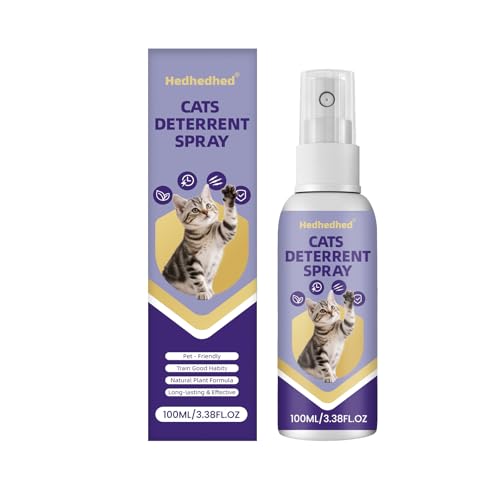
Hedhedhed Cat Deterrent Spray

A clear-formula deterrent designed to treat upholstery and doorways without leaving a visible mark.
Best for: owners who want a gentle, no-stain deterrent for specific "off-limits" zones — a favourite armchair, a bedroom doorway, a windowsill full of plants.
The appeal here is the clear formulation. Because it dries without colour, it is one of the easier options to use on pale linen, light oak and painted trim where a tinted spray would show. It works on scent aversion rather than any startle effect, so the cat simply investigates, dislikes what it smells and redirects itself.
Pros:
- Plant-based, non-toxic actives that are safe around pets and children once dry
- Clear formula leaves no visible residue on fabric or wood
- Discourages scratching and territory-testing without stress or startle
- Manufactured to consistent commercial quality standards
Cons:
- Needs frequent reapplication in outdoor and high-traffic areas
- Targets cats only — no effect on rodents, insects or other wildlife
Practical tip: treat a 20–30 cm border around the object, not just the object itself. Cats commit to a surface before they touch it, so the "approach zone" is what you actually want to make unappealing.
👉 Check the current price and pick up a clear-formula bottle for your sofa.
Bodhi Dog 3-in-1 Cat & Kitten Training Aid

An 8 oz US-made formula intended for furniture, rugs and potted plants in one bottle.
Best for: households juggling several problem surfaces at once — a scratched sofa arm, a rug corner and a fern the kitten keeps chewing.
The "3-in-1" positioning is the point: one formula rated for upholstery, floor coverings and greenery means you are not buying three separate bottles or worrying about which one is safe on which surface. It is made in the USA, which typically brings tighter batch-testing than unbranded imports.
Pros:
- Made in the USA to consistent manufacturing standards
- One formula covers furniture, rugs and plants
- Safe on treated surfaces when used as directed
- Practical 8 fl oz size with a usable trigger sprayer
- Works well as the deterrent half of a redirect-and-deter plan
Cons:
- Outdoor coverage needs reapplying after heavy rain
- Some cats take several days of consistent treatment before they respond
- Packaging is plain — no visual level indicator
In practice: kittens respond faster than adults. Treat problem surfaces the week you bring a kitten home rather than waiting for the first shredded cushion.
👉 Grab the 8 oz bottle and protect furniture, rugs and plants with one formula.
Messy Pet Cat Pet Training Aid & Deterrent Spray Bottle

Twin 27 oz bottles — the volume option for people treating whole rooms or large outdoor areas.
Best for: large homes, multi-cat households and anyone who has burned through three tiny 100 ml bottles in a fortnight.
At 27.05 fl oz per bottle and sold in pairs, this is the highest-volume option on the list by a wide margin. That matters more than it sounds: the single biggest reason deterrent training fails is that people ration the spray to make the bottle last, apply too lightly, and never build the consistent scent barrier the cat needs to learn from. Volume removes that temptation.
Pros:
- 27.05 fl oz per bottle for genuinely long-lasting use
- Two-bottle pack lets you keep one upstairs and one down
- Simple, reliable trigger sprayer for fast coverage
- Non-toxic formula from Scott's Liquid Gold, a long-established household brand
- Compact 11.25 × 3.25 × 3.25 inch footprint for cupboard storage
Cons:
- Opaque liquid makes it harder to judge the remaining level at a glance
- Response varies with individual temperament
👉 Stock up on the twin 27 oz pack so you never ration your coverage.
SINROBO Cat Deterrent Spray

A dual-purpose formula aimed at both scratching and urine-marking hotspots.
Best for: owners dealing with two behaviours at once — a cat that scratches the sofa corner and sprays the same wall.
The dual claim is what separates it. Scratch deterrence and marking deterrence usually need different products, so a single clear formula that addresses both simplifies things — provided you clean the marked area thoroughly first. Deterrent on top of un-neutralised urine residue rarely holds.
Pros:
- Natural repellent formula safe for pets and people
- Targets both anti-scratch and urine-marking behaviour
- Rated for furniture, walls and outdoor surfaces
- Clear liquid that applies without staining
- Consistent commercial manufacturing
Cons:
- Stubborn cats may need repeated daily applications for a week or more
- Effectiveness varies with individual temperament
Order of operations matters: enzyme cleaner → let dry fully → deterrent spray. Skip step one and you are layering scent on scent.
👉 Tackle scratching and marking with one clear, natural formula.
hply tea Cat Deterrent Spray (2 × 100 ml)

Two compact 100 ml bottles — easy to keep one by the sofa and one in a travel bag.
Best for: targeted spot treatment, small flats, and taking on holiday or to a new home where a cat may test unfamiliar furniture.
Small bottles have a real advantage that big ones don't: you actually keep one in the room where the problem is. A 100 ml bottle sits behind a cushion or on a shelf and gets used the moment you spot fresh claw marks — which is when reapplication does the most good.
Pros:
- Natural, non-toxic ingredients suitable for sensitive households
- Genuinely effective on scratching hotspots
- Rated for indoor and outdoor surfaces
- Twin 100 ml pack for two-room coverage
- Bright packaging is easy to find in a cluttered cupboard
Cons:
- Small volume drains quickly in high-traffic zones
- The botanical scent is noticeable to sensitive noses for the first hour
👉 Keep a 100 ml bottle in every problem room for instant touch-ups.
Cudory 2-Pack Cat Deterrent Spray (Indoor & Outdoor)

Rated for cords and walls as well as furniture — useful in homes with a cable-chewing kitten.
Best for: cable chewers, wall scratchers and plant nibblers. The explicit cord rating is the standout, because chewed charging cables and lamp flexes are a genuine electrical and choking hazard, not just a nuisance.
Pros:
- Deters scratching and marking across multiple surface types
- Rated safe for furniture, walls, cords and plants
- Two-bottle pack extends coverage indoors and out
- Straightforward spray application
- Distinctive bottle colour makes it easy to identify
Cons:
- High-traffic areas need reapplying every couple of days
- Initial scent is noticeable to some people
Safety note: treat the cord and fix the root cause — bundle loose cables in a protective sleeve. Deterrent spray is a layer of defence, not a substitute for cable management.
👉 Protect cords, walls and plants with the two-bottle set.
MUOCOBU Cat Deterrent Spray 200 ml

A no-trace garden and furniture formula in a middle-ground 200 ml size.
Best for: gardeners. If neighbourhood cats are digging in raised beds or your own cat is using the vegetable patch as a litter tray, an outdoor-rated no-trace formula is the tool for the job.
The 200 ml size sits usefully between pocket bottles and bulk jugs — enough to treat a bed border several times over without becoming awkward to carry down the garden.
Pros:
- No-trace formula that won't mark decking, stone or upholstery
- Rated for both interior and exterior surfaces
- Fast-acting on first application
- Convenient 200 ml size for one-handed use
- Plant-derived alternative to synthetic chemical repellents
Cons:
- Rain washes it off; reapply after any downpour
- Results vary between individual cats
Outdoor reality check: treat the perimeter of a bed and any low wall the cat uses to enter. Spraying only the soil misses the approach route.
👉 Defend borders and planters with a 200 ml no-trace outdoor formula.
PET YOUR PET No Pee No Poop Cat Potty Training Spray

A 16 oz deterrent aimed specifically at repeat soiling and marking spots.
Best for: repeat offenders — the corner behind the sofa, the same patch of carpet by the back door, the doormat.
Marking is a communication behaviour, not a cleanliness failure. It usually traces back to territorial insecurity, a litter tray the cat dislikes, or a medical issue. This spray handles the location half of that equation while you fix the rest. It works particularly well in multi-cat homes, where several cats sharing overlapping territory produce most marking incidents. Pair it with dedicated trays for busy households — the rule of thumb is one tray per cat plus one spare, spread across different rooms.
Pros:
- Non-toxic formula, safe around cats and people once dry
- Targets urine marking and inappropriate defecation specifically
- Rated for indoor carpets and outdoor beds alike
- Generous 16 fl oz volume
- Natural composition with no harsh solvents
Cons:
- Persistent markers may need daily treatment for two weeks
- Won't work alone if the underlying cause isn't addressed
👉 Break the repeat-soiling cycle with a 16 oz targeted formula.
EZPRO USA Empty Spray Bottles, 12 oz PET Plastic (Pack of 4)
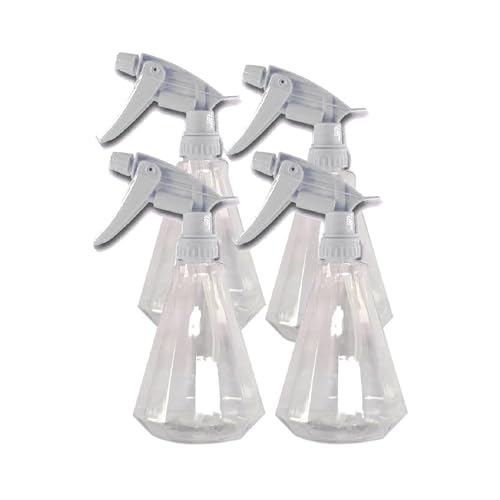
Clear PET bottles you fill yourself — the base kit for DIY deterrents and grooming mists.
Best for: DIY households and anyone who wants a dedicated bottle per solution.
This is the actual "spray bottle for cat training" in the literal sense. Four clear 12 oz PET bottles let you label and separate everything: one for citrus deterrent, one for plain water to dampen a grooming coat, one for diluted enzyme cleaner, one spare. Clear plastic means you can see the level and, importantly, spot cloudiness or sediment in a homemade mix that has gone off.
Pros:
- Durable PET plastic resists cracking and leaking
- Transparent walls show liquid level and mix condition
- 12 oz size is easy to hold and aim one-handed
- Multi-purpose: DIY deterrents, grooming mists, plant watering
- Four-pack lets you dedicate one bottle per liquid, avoiding cross-contamination
Cons:
- Nozzles need occasional rinsing to prevent clogging from homemade mixes
- Clear only — colour-code with tape or a label instead
Maintenance tip: flush the nozzle with warm water after every homemade citrus or vinegar batch. Plant residue is the number one cause of a spray head that dribbles instead of misting.
👉 Build your own DIY deterrent kit with a four-pack of refillables.
SINROBO Cat Deterrent Spray (Indoor & Outdoor Training Aid)
The same clear SINROBO formula in an alternative listing — useful when the first is out of stock.
Best for: cats that split their time between house and yard, so the same boundaries need enforcing in both places.
Consistency across environments is genuinely underrated. A cat that learns the potted palm indoors is off-limits but the outdoor planter is fair game will keep testing both. Treating indoor and outdoor equivalents with the same scent shortens the learning curve considerably.
Pros:
- Safe, non-toxic formula for household use
- Effective against both marking and scratching
- Rated for indoor and outdoor application
- Easy trigger bottle for fast touch-ups
- Consistent commercial manufacturing quality
Cons:
- Repeated applications needed for determined cats
- Some cats show little reaction on the first exposure
👉 Apply one consistent boundary scent indoors and out.
How to Apply Deterrent Spray Properly: 6 Steps
- Clean first. Vacuum, then treat any soiled area with an enzymatic cleaner and let it dry completely. Deterrent over stale scent marks rarely works.
- Spot-test. Hidden corner, one hour, check for staining. Non-negotiable on leather, silk and unsealed wood.
- Spray the approach, not just the target. Cover a 20–30 cm border around the object and any launch point (chair arm, windowsill, radiator cover).
- Mist, don't soak. A light, even film from about 20 cm away. Saturating fabric wastes product and slows drying.
- Reapply on a schedule. Every 24–48 hours for the first week, then stretch the interval as the behaviour drops off. Outdoors, after every rain.
- Log what changes. A note on your phone — surface, date, cat's reaction — tells you within a week whether the formula is working or whether you need a different mechanism.
Expect a noticeable reduction within 5–10 days of consistent use. If nothing has changed after two weeks of correct application, the problem is almost certainly motivational rather than scent-related, and the next section matters more than the spray.
Redirect, Don't Just Deter
This is the part most articles skip, and it is the single biggest predictor of success. A deterrent closes a door. If you don't open another one, the cat simply finds a new door.
For scratching: cats scratch to shed claw sheaths, stretch the spine and leave scent marks. Deny the sofa without providing an alternative and they'll pick the rug. Place a sturdy sisal post — at least 75 cm tall so an adult can stretch fully — directly beside the treated furniture, then move it a few centimetres per week once it's being used. Reward every voluntary use immediately with small, high-value rewards so the new surface pays better than the old one.
For counters and shelves: cats climb for vantage points. A cat tree by a window or a wall shelf near the kitchen gives the same elevation legally. This kind of substitution sits at the heart of any structured approach to teaching new household habits.
For precision: if you want the cat to understand exactly which action earned the treat, a precise marker sound closes the gap between behaviour and reward far better than praise alone. Timing within half a second is what makes it work.
For litter-related problems: deterrent spray on the carpet is a patch, not a fix. Check that the tray is uncovered, large enough for the cat to turn around in comfortably, and cleaned daily. An appropriately sized tray in a quiet, low-traffic spot resolves a surprising share of "training" problems on its own, and smell-controlling designs keep the box attractive enough that the cat keeps choosing it. Where ammonia builds up between scoops, an odour-neutralising additive helps more than any deterrent aimed at the carpet.
DIY Natural Deterrents — and the Ingredients to Avoid
Refillable bottles make homemade solutions cheap. But this is also where well-meaning owners cause real harm, so read the warning list first.
Safe(r) homemade recipes
Citrus mist
- 250 ml water
- 2 tbsp fresh lemon or orange juice, strained
- Optional: a few strips of zest steeped for 24 hours, then removed
Shake before each use, refrigerate, and discard after 5–7 days — homemade botanical mixes ferment.
Herbal infusion
- 250 ml boiled water
- 1 tbsp dried rosemary and 1 tbsp dried lavender
- Steep 30 minutes, strain thoroughly (unstrained plant matter clogs nozzles)
Diluted vinegar (hard surfaces only)
- 1 part white vinegar to 3 parts water
- Skirting boards, tiles, sealed concrete. Never on natural stone, waxed wood or upholstery.
⚠️ Never use these around cats
Cats lack an efficient liver enzyme pathway for processing certain compounds, which makes several "natural" products genuinely toxic:
- Tea tree oil — highly toxic even in dilute form
- Undiluted citrus, pine, wintergreen, peppermint and eucalyptus essential oils — phenols and terpenes are readily absorbed through skin and paws
- Cinnamon, clove and thyme essential oils
- Any concentrated essential oil applied to a surface a cat will walk on and later groom
Fruit juice and dried herbs are not the same thing as concentrated essential oil. If a homemade mix causes drooling, vomiting, wobbliness or laboured breathing, wash the cat's paws with mild soap and call your vet immediately.
Common Mistakes That Sabotage Deterrent Training
| Mistake | What happens | Fix |
|---|---|---|
| Spraying the cat instead of the surface | Fear of you, secret scratching | Point the bottle at furniture only |
| Skipping enzymatic cleaning | Old scent marks override the deterrent | Clean, dry fully, then treat |
| Applying once and quitting | Scent fades in 24–72 hours; nothing is learned | Reapply on a schedule for 2 weeks |
| No alternative offered | Behaviour relocates to a new surface | Post, cat tree or extra tray beside the treated zone |
| Soaking the fabric | Stains, slow drying, wasted product | Light, even mist from 20 cm |
| Household inconsistency | One person allows the counter, another doesn't | Agree one rule; everyone follows it |
| Treating a medical problem as behaviour | Condition worsens untreated | See below |
When It Isn't a Training Problem
Some behaviours that look like defiance are medical. Book a vet appointment rather than reaching for a spray if you notice:
- Sudden urination outside the tray in a previously reliable cat — commonly urinary tract disease, crystals or a blockage. Straining with little or no urine in a male cat is a same-day emergency.
- Increased thirst plus larger urine clumps, often alongside weight loss — worth investigating kidney function, especially in cats over seven. Diagnosis usually brings dietary changes, and renal-support formulas are typically part of the long-term plan.
- Frantic scratching combined with over-grooming or bald patches — often skin allergy or parasites rather than territorial marking.
- Any behaviour change that appears abruptly in an adult cat.
Nutrition plays a quieter role too: a cat on a well-formulated diet with adequate moisture is generally a calmer, more comfortable cat, and switching to better-quality moist meals sometimes resolves litter-tray reluctance that no spray would have touched.
Frequently Asked Questions
Is it ever OK to squirt a cat with water?
Behaviour professionals no longer recommend it. Water-squirting suppresses the behaviour only while you are watching, and it teaches the cat to associate you with unpleasant surprises. Environmental deterrents and reward-based redirection achieve better results and preserve the relationship.
What ingredients make cat deterrent sprays safe?
Look for plant-derived actives — rosemary, lemongrass, cinnamon extract, bitter agents — in a water base, with no phenols, no tea tree oil and no concentrated essential oils. "Non-toxic" on a label should mean safe once dry on a surface the cat may later groom. If a manufacturer won't disclose its ingredient list, choose a different brand.
How long before a deterrent spray works?
Most cats begin avoiding a treated surface within 3–7 days of consistent daily application. Give any product a fair two-week trial before judging it, provided you are also cleaning properly and offering an alternative. Kittens and young cats usually adapt faster than set-in-their-ways adults.
How often should I reapply?
Every 24–48 hours during the first two weeks, then every 3–4 days as the habit fades. Reapply immediately after vacuuming, shampooing or wiping the surface, and after any rainfall outdoors.
Will deterrent spray stain my furniture?
Clear, no-trace formulas are designed not to. Even so, spot-test every new surface — an inconspicuous corner, one hour, check when dry. Take extra care with leather, silk, velvet, unsealed wood and natural stone.
Do these sprays work on outdoor cats in the garden?
Yes, though maintenance is higher. Treat the border and the entry route rather than just the digging patch, reapply after rain, and combine the spray with physical measures — chicken wire laid flat under mulch, or dense planting — for reliable results.
Can I use one spray for both scratching and urine marking?
Some dual-purpose formulas cover both. But marking always needs enzymatic cleaning first, plus attention to the underlying cause: territorial tension, an unappealing litter setup or a medical issue. The spray is the last step, never the only one.
Can I use an empty bottle for homemade deterrents?
Absolutely — clear refillable PET bottles are ideal, since you can see the level and check for cloudiness. Use a fine-mist nozzle for even coverage, rinse it after every batch, label each bottle by contents, and discard homemade botanical mixes after about a week.
Does spray training work for kittens?
It works better with kittens, because you are shaping a habit rather than breaking one. Treat vulnerable surfaces before the kitten arrives, provide scratching posts from day one, and reward every correct choice generously.
The Bottom Line
The spray bottle earns its place in cat training — pointed at the furniture, not the cat. Modern deterrent sprays use plant-based scents and bitter agents to make a sofa arm, planter or doorway simply not worth investigating, and they work whether or not you are in the room. That passive consistency is what changes behaviour.
Three things decide whether it works for you:
- Clean the surface properly before treating it.
- Reapply on a schedule for at least two weeks — not once, hopefully.
- Always offer a better alternative — a tall sisal post, a window perch, a cleaner litter tray — and reward the cat for choosing it.
Skip any of those and even the best formula underperforms. Do all three and most scratching and marking problems ease noticeably within a fortnight, without a single fearful moment for your cat.
Ready to start? Pick one deterrent matched to your actual problem — anti-scratch for furniture, anti-marking for repeat soiling, or a four-pack of refillables if you'd rather mix your own — treat the problem surface tonight, and set a phone reminder to reapply in 24 hours. That one reminder is the difference between a bottle that sits in a cupboard and a sofa that survives the year.