
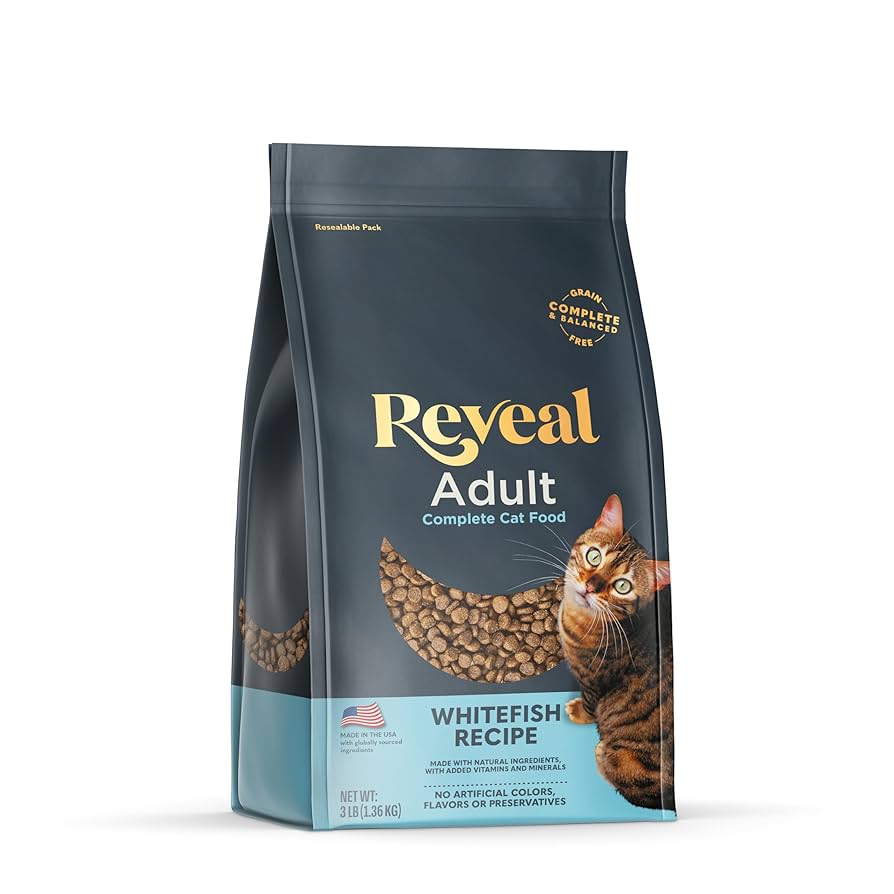
Short answer: most Reveal cat food is a complementary food, not a complete-and-balanced diet. The shredded chicken, tuna, salmon and mackerel packed in broth or water are designed to sit alongside a nutritionally complete meal — not replace it. That doesn't make Reveal a bad product. It makes it the wrong product if you're feeding it as your cat's only food.
The confusion is understandable. The cans look wholesome, the ingredient lists are refreshingly short, and you can literally see the fish fillet through the broth. But "clean ingredients" and "complete nutrition" are two completely different claims, governed by two completely different sets of rules. This guide walks you through exactly how to tell them apart — on the label, in the feeding bowl, and in your cat's long-term health.
The Quick Verdict
| Question | Answer |
|---|---|
| Is Reveal complete and balanced? | Generally no — most SKUs carry a "complementary" / "intermittent or supplemental feeding" statement |
| Can it be a cat's only food? | No, unless that specific can states complete and balanced for a life stage |
| Is the ingredient quality good? | Yes — real muscle meat/fish, no artificial colours, flavours or preservatives |
| Best use case | Topper, hydration booster, appetite stimulant, treat, pill disguise |
| Who should be careful | Kittens, seniors, cats with kidney disease, diabetic or overweight cats |
What Reveal Cat Food Actually Is
Reveal built its reputation on visual transparency. Instead of the homogenised pâté most brands sell, you get identifiable pieces — a chicken breast fillet, a tuna loin, a salmon cut — suspended in broth or water. Ingredient lists are often three or four items long: the protein, the liquid, and sometimes a single vegetable or a natural gelling agent.
That minimalism is exactly why it isn't complete nutrition.
A cat's daily diet has to deliver more than protein and water. It needs a full micronutrient package: taurine, vitamin A (cats can't convert beta-carotene efficiently), vitamin D, arachidonic acid, calcium and phosphorus in a workable ratio, plus B vitamins, zinc, iodine and more. Complete diets get there by adding a vitamin-mineral premix. A can of plain fish in broth, by definition, contains none of that.
In practice, this is the single biggest misunderstanding I see among owners: the assumption that "fewer, better ingredients" automatically equals "healthier complete meal." For a topper, minimal is a virtue. For a sole diet, minimal is a deficiency.

The visible whole-muscle pieces are the brand's selling point — and a clue that no vitamin premix has been blended in.
Credit: www.amazon.com
The Label Test: How to Prove It in 10 Seconds
Forget the front of the pack. Turn the can over and find the nutritional adequacy statement — a small block of text, usually near the guaranteed analysis. It will say one of three things:
-
"[Product] is formulated to meet the nutritional levels established by the AAFCO Cat Food Nutrient Profiles for [life stage]."
→ Formulated to be complete. Safe as a sole diet. -
"Animal feeding tests using AAFCO procedures substantiate that [Product] provides complete and balanced nutrition for [life stage]."
→ Complete and proven by a feeding trial. The stronger of the two claims. -
"For intermittent or supplemental feeding only" — or, on some packaging, "complementary pet food."
→ Not complete. This is where the bulk of Reveal's range sits.
The framework behind those sentences comes from the Association of American Feed Control Officials, whose nutrient profiles are the working standard for pet food in the United States. Labelling and safety enforcement itself falls to the U.S. Food and Drug Administration, which regulates pet food as animal feed and requires that claims on the package be truthful and not misleading.
Do this today: pull every wet food can out of your cupboard and read the adequacy statement on each one. Owners are routinely surprised to find that two or three of their "regular" foods are toppers.
The life-stage detail people skip
"Complete and balanced" is always tied to a life stage: growth and reproduction, adult maintenance, or all life stages. A food that's complete for an adult may fall short of a kitten's calcium and protein needs. If a Reveal recipe (or any recipe) claims completeness, check which life stage it claims it for.
What's Inside — and What's Missing
Here's an honest breakdown of what a typical Reveal can delivers versus what a full diet requires.
What it does well:
- High-quality protein. Whole muscle meat and fish are highly digestible and rich in the amino acids cats depend on.
- Moisture. Cats evolved from desert ancestors and have a weak thirst drive. Broth-packed food is one of the easiest ways to raise total water intake — genuinely useful for urinary health.
- Low ingredient complexity. Helpful when you're trying to identify a food trigger during an elimination trial.
- No artificial colours, flavours or preservatives. Not strictly a health requirement, but a reasonable preference.
What it doesn't do:
- No added vitamin-mineral premix. No supplemental vitamin A, D, E, B-complex, zinc, iodine or copper in meaningful amounts.
- Little to no added taurine. Fish and poultry contain natural taurine, but levels vary by cut and are reduced by processing. Complete canned diets are formulated to hold at least the AAFCO minimum on a dry-matter basis; a plain fillet in water isn't formulated for anything.
- No calcium source. Boneless muscle meat is phosphorus-rich and calcium-poor. Fed exclusively over months, that inverted ratio is a real skeletal risk.
- Very low calorie density. These are small, watery cans. They fill a bowl without filling a calorie requirement.
The last point matters more than owners expect. A typical 10 lb adult cat needs somewhere in the region of 180–220 kcal per day. Small broth-packed cans contribute only a modest fraction of that. Feed enough of them to hit the calorie target and you've spent a lot of money on a diet that's still nutritionally incomplete.

Flavour rotation helps with fussy eaters, but variety across incomplete recipes still doesn't add up to a balanced diet.
Credit: www.amazon.com
The Nutrients a Complete Cat Diet Must Cover
This is the checklist a formulator works against. Use it to understand why a two-ingredient can can't stand alone.
| Nutrient | Why cats need it | What happens when it's short |
|---|---|---|
| Taurine | Heart muscle, retina, bile salts | Dilated cardiomyopathy, retinal degeneration |
| Arachidonic acid | Cats can't make it from linoleic acid | Poor skin/coat, reproductive issues |
| Vitamin A (preformed) | Cats can't convert plant carotenoids well | Night vision loss, poor coat, immune decline |
| Vitamin D | Calcium absorption; cats can't synthesise it in skin | Rickets, bone weakness |
| Calcium : phosphorus | Skeletal integrity | Meat-only diets skew badly toward phosphorus |
| Thiamine (B1) | Nerve and brain function | Neurological signs; destroyed by heat and by raw-fish thiaminase |
| Zinc, iodine, copper | Skin, thyroid, enzyme function | Hair loss, thyroid dysfunction, anaemia |
AAFCO's adult maintenance profile sets minimums on a dry-matter basis — protein and fat floors plus dozens of vitamin and mineral minimums. Complete foods are formulated to hit every one. Complementary foods aren't trying to.
If you want a deeper walkthrough of how those numbers translate into shopping decisions, our breakdown of what actually makes a formula nutritionally sound covers dry-matter maths in plain English.
How to Feed Reveal the Right Way
Used as intended, Reveal is genuinely useful. Here's the practical framework.
1. Apply the 10% rule
Keep all treats, toppers and complementary foods to roughly 10% or less of daily calories. The other 90% comes from a food carrying a complete-and-balanced statement. This is the standard veterinary guideline, and it exists precisely so that incomplete extras can't unbalance the core diet.
2. Use it as a hydration tool
Drain nothing. The broth is the point. Spoon a whole can — liquid included — over your cat's regular wet food to bump total water intake. Cats prone to urinary crystals or constipation often benefit noticeably within a couple of weeks.
3. Use it to restart a stalled appetite
A cat recovering from illness, or one refusing a new therapeutic diet, will often eat a broth-topped bowl when it won't touch the plain version. Warm it slightly to body temperature to release aroma — a trick that works better than almost any additive.
4. Use it as a pill vehicle or training reward
The shreds break apart easily and hide small tablets well. They also work as a high-value reward if you're doing any behaviour shaping with your cat, though most owners find dedicated high-value reward morsels easier to portion for repeated sessions.
5. Transition slowly
Even a topper can upset a sensitive gut. Introduce a quarter can for two or three days, then half, then whole. Watch stool quality. A common mistake is adding a full can on day one and blaming the protein source for what was really a volume-and-fat change.
Choosing the Complete Food It Sits On Top Of
Since Reveal is the accessory, the base diet is the decision that actually matters. Look for:
- An AAFCO adequacy statement matching your cat's life stage
- Named protein sources in the first two ingredients
- A stated kcal/can or kcal/kg so you can portion accurately
- Phosphorus and sodium figures if your cat has any renal or cardiac history
- A manufacturer that employs qualified nutritionists and runs its own quality testing
Our roundup of top-performing canned formulas is a good starting shortlist, and there's a broader comparison of everyday canned options if you're rotating textures for a fussy eater.

Whole-muscle shreds in a watery broth: excellent for hydration, low in calories, and unfortified.
Credit: www.amazon.com
Who Should Be Extra Careful
Kittens
Growth is the least forgiving life stage. Kittens need higher protein, higher calorie density, and a tightly controlled calcium-to-phosphorus ratio. Displacing even a modest share of a growth diet with unfortified meat can affect bone development. Keep toppers minimal until they're a year old.
Senior cats and cats with kidney disease
Muscle meat and fish are phosphorus-dense. In cats with chronic kidney disease, phosphorus restriction is one of the few interventions with strong evidence behind it — so adding an unrestricted topper can quietly undo a therapeutic diet. Talk to your vet first, and if you're building a renal feeding plan, our guide to diets formulated for renal support explains what to look for on the label.
Cats with food sensitivities
The short ingredient list is a genuine advantage here — fewer variables to eliminate. But fish is itself a fairly common feline allergen, and repeated fish feeding raises other considerations (mercury, thiaminase in raw fish, and simple flavour fixation). Rotate proteins rather than defaulting to tuna every day.
Overweight or diabetic cats
Toppers are calories. They're low-calorie toppers, which helps, but they still count. Weigh food rather than eyeballing it, and subtract topper calories from the base meal.
Multi-cat households
Cats eat at different rates and different times. If you portion wet food on a schedule, a timed dispenser built for wet meals prevents the fastest eater from claiming both bowls — and keeps the topper with the cat it was intended for.
Reveal vs. a Complete Wet Food: The Real Comparison
| Factor | Reveal (complementary) | Complete wet diet |
|---|---|---|
| Adequacy statement | Intermittent/supplemental | Complete & balanced for a life stage |
| Vitamin-mineral premix | Not added | Added and formulated |
| Calories per can | Low | Moderate to high |
| Moisture | Very high | High |
| Cost per 100 kcal | High | Lower |
| Best role | Topper, hydration, treat | Daily meals |
Judged as a topper, Reveal competes well: clean sourcing, visible ingredients, cats generally love it. Judged as a meal, it isn't in the same category — and comparing it to complete diets on "quality" alone misses the point entirely.
Common Mistakes Owners Make
- Reading "natural" as "complete." Unrelated claims. One is about sourcing; the other is about formulation.
- Feeding two or three cans a day as the whole diet. The most consequential error on this list.
- Assuming variety fixes it. Five different incomplete recipes are still incomplete.
- Ignoring calories. Toppers push daily intake up while the base portion stays the same.
- Not reporting changes to the vet. Weight loss, dull coat, or reduced activity after a diet change deserves a conversation, not a wait-and-see.
Diet also shows up in the litter box before it shows up anywhere else. Sudden shifts in stool volume, odour or urination frequency are worth noting — and if odour control is already a struggle, a box designed to trap smells makes those changes far easier to spot early.
Frequently Asked Questions
Is Reveal cat food complete and balanced?
Generally no. The majority of Reveal's shredded-meat-in-broth products are labelled as complementary or "for intermittent or supplemental feeding only." Always read the nutritional adequacy statement on the specific can or pouch you're holding — ranges change, and a brand may add complete recipes over time. If the statement doesn't say complete and balanced, it isn't.
Is Reveal a good-quality cat food?
For what it is, yes. Whole-muscle protein, minimal processing, no artificial colours or preservatives, and high palatability. The quality question and the completeness question are separate — Reveal scores well on the first and simply isn't competing on the second.
How do I know if any cat food is nutritionally complete?
Look for an AAFCO statement saying the product is "formulated to meet" the AAFCO Cat Food Nutrient Profiles, or that "animal feeding tests using AAFCO procedures substantiate" complete and balanced nutrition — plus a named life stage. Anything phrased as intermittent, supplemental or complementary is a topper.
Do vets recommend Reveal cat food?
Many vets are comfortable recommending it as a topper, hydration aid or appetite stimulant, especially for cats that need more water in their diet. Very few would recommend it as a sole diet, for the reasons above. Your own vet's advice, based on your cat's bloodwork and body condition, outranks any general guidance.
Can I mix Reveal with dry food?
Yes, and it's one of the better uses for it. Adding broth-packed shreds to kibble raises moisture intake and makes dry food more appealing to fussy eaters. Just make sure the kibble itself carries a complete-and-balanced statement, and account for the extra calories.
How much Reveal is safe per day?
As a rule of thumb, keep it under 10% of daily calories. For a typical 10 lb adult cat, that's a small fraction of one can's worth of added energy — check the kcal figure on the label and portion accordingly rather than guessing.
Does the broth count as water intake?
It does, and that's one of its real benefits. Cats that don't drink much from a bowl will readily take fluid in food form. This is particularly valuable for cats with a history of urinary crystals, cystitis or constipation.
Is fish-based Reveal safe long term?
As an occasional topper, fine. As a daily staple, rotate proteins. Heavy long-term fish feeding raises concerns around mercury accumulation, flavour fixation, and — in some sensitive cats — allergy development.
The Bottom Line
Reveal cat food is not complete nutrition, and it was never designed to be. It's a well-made complementary food: real meat and fish, honest labelling, excellent moisture content, and the kind of palatability that gets a reluctant cat eating again. Those are real strengths.
The mistake is asking it to do a job it doesn't claim to do. Build your cat's diet on a food that carries a complete-and-balanced AAFCO statement for the right life stage, then use Reveal on top — for hydration, for enrichment, for hiding a tablet, for tempting a cat off a hunger strike. Cap it at roughly 10% of daily calories, transition slowly, and watch weight and coat condition over the following month.
Next step: flip over every can and bag in your cupboard tonight and check the adequacy statement. If your cat's main food doesn't say "complete and balanced," fix that first — then browse our tested picks for canned nutrition to find a base diet worth building on.